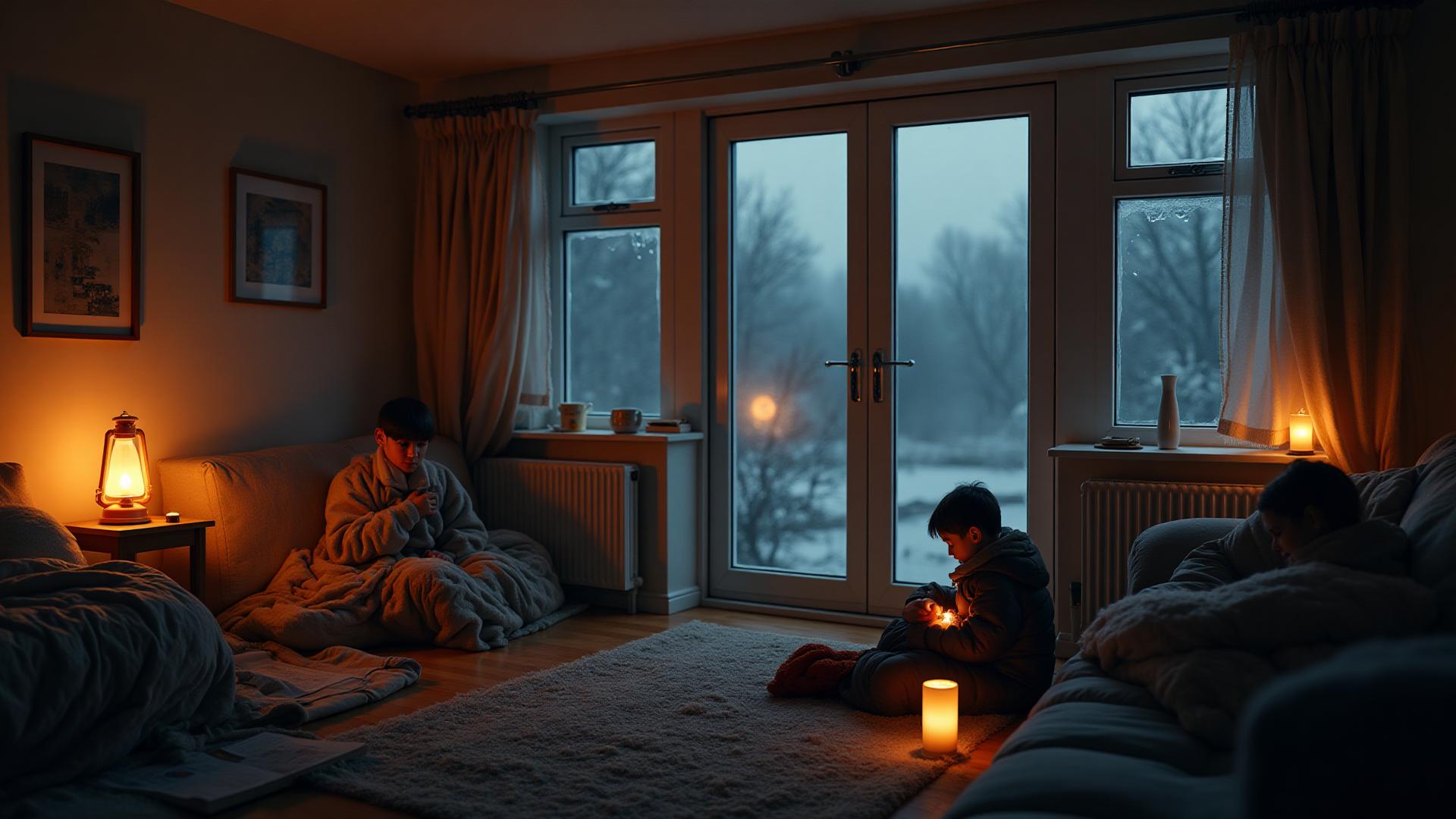
When winter hits the UK, it doesn't always announce itself with drama.
Sometimes you simply wake to a quiet cold you weren't expecting: frost thick on the window, a house that feels sharper in the air, the radiators not responding when you twist the dial. You check your phone — no signal. The lights won't turn on. And without meaning to, your mind runs the numbers of how long you can keep the warmth in.
Cold snaps in the UK aren't unusual. But the way we live now — thin-walled new builds, widespread boiler reliance, an overstretched grid, and increasing energy costs — means that staying warm through winter has become less instinctive, more precarious. And during blackouts, storms, or heating failures, the cold becomes a force that moves through the house faster than people expect.
This guide is built for exactly those moments. Not panic-driven survivalism — but practical, human, science-backed cold weather survival for the UK, covering hypothermia prevention, home heat loss, and staying safe during winter blackouts.
It's written for the ordinary family, the elderly resident, the rural homeowner, the city renter — anyone who wants to stay safe when winter pushes back harder than expected.
Understanding Cold Weather Risks: Why the UK Is More Vulnerable Than It Seems
The UK's cold isn't the deepest in Europe, but it's uniquely dangerous because of infrastructure fragility and home insulation gaps — two factors often underestimated.
1. UK Homes Lose Heat Fast — Far Faster Than People Expect
- Many UK homes rely entirely on gas boilers.
- Loft insulation varies drastically across housing stock.
- Older terraces and Victorian homes leak heat through floors, windows, and chimneys.
- Modern flats often use electric heating — useless during grid failures.
2. Winter Blackouts Are Becoming More Common
Storm-related outages, energy shortages, and grid instability mean:
- Radiators stop.
- Smart meters freeze.
- Electric cookers die.
- Phones and routers shut down.
Most winter blackout scenarios overlap with low temperatures + no heat source, a combination that accelerates hypothermia risk indoors. Learn more about UK power cut survival.
3. Cold-Related Illnesses Increase During Energy Poverty
According to NHS and UKHSA data:
- Hypothermia risk rises even at indoor temperatures below 15°C.
- Respiratory illness worsens with prolonged cold exposure.
- Elderly residents lose body heat significantly faster.
Cold is not an inconvenience — it is a physiological stressor.
4. The Hidden Danger: Temperature Drop Rate in an Unheated House
The answer:
In many UK homes, temperatures drop below safe levels within 4–12 hours, depending on insulation, wind chill, and outdoor temperature.
Hypothermia Prevention: What Every UK Household Must Know
Hypothermia doesn't require snowstorms or freezing temperatures. It begins quietly, gradually — and often indoors.
Recognising Early Hypothermia Symptoms
By medical consensus, the earliest signs include:
- Shivering that becomes uncontrollable
- Pale or cold skin
- Slowed speech or mumbling
- Fatigue, confusion, "foggy thinking"
- Clumsiness or stumbling
- In infants: cold hands/feet, quietness, unusually still behaviour
These symptoms escalate fast in a cold home.
Core Body Temperature Thresholds
Understanding these numbers is crucial:
- 35°C — Hypothermia begins
- 32°C — Severe impairment
- 28°C and below — Life-threatening
Most people underestimate how quickly their core temperature drops when the house hits 10–12°C.
Immediate Prevention Steps When the Heat Fails
This is the lifesaving part.
- Move everyone into a single "warm room" — Choose the smallest room with the fewest windows, ideally south-facing.
- Layer clothing strategically — Base layer: moisture-wicking. Mid-layer: fleece or wool. Outer layer: wind-resistant. Wool is king — it maintains warmth even when damp.
- Use body heat pairing — Children and elderly adults warm faster when placed in close contact under shared blankets.
- Keep feet, hands, and head covered — These extremities lose heat quickly.
- Increase calorie intake — The body burns energy to stay warm — warm meals and sugary drinks help stabilise temperature.
How Heat Escapes a UK Home — And How to Stop It
Heat loss isn't mysterious. It has patterns — and you can interrupt every one of them.
1. Windows — Up to 30% of Heat Loss
Even double glazing loses heat at the edges. Prevent it:
- Thick curtains closed
- Towels or draft snakes at sills
- Reflective foil or blankets taped over glass
- Furniture pulled away from leaky windows (prevents convection currents)
2. Doors — 10–20% Heat Loss
Gaps under doors create wind tunnels. Prevent it:
- Rolled towels
- Draft excluders
- Blankets pinned to door frames
3. Floors — Especially in Older UK Homes
Bare wooden floors leak heat straight into crawl spaces. Prevent it:
- Rugs
- Towels
- Spare bedding
- Yoga mats or cardboard layers
4. Chimneys — A Major Escape Route
Many unused fireplaces allow heat to vanish up the flue. Prevent it:
- Chimney balloons
- Rolled towels
- Temporary cover using cardboard + tape (removed before relighting!)
5. Electrical Cavity Gaps & Loft Hatches
Warm air rises. And escapes. Prevent it:
- Thick blankets over loft hatches
- Blocking known cavity gaps
- Closing all internal doors
Building a Warm Room: The UK's Most Effective Cold-Weather Survival Technique
Here is the complete warm-room method engineered for UK homes.
Step-by-Step Warm Room Setup
- Step 1 — Choose the Right Room: Smallest, lowest, warmest. Living rooms often work best.
- Step 2 — Insulate the Perimeter: Seal windows, close internal doors, block vents if safe, lay blankets on floors.
- Step 3 — Create Heat Zones: Cluster people together. Use sleeping bags inside blankets to trap body heat.
- Step 4 — Reflect Heat: Place reflective foil or emergency blankets behind bodies and light sources.
- Step 5 — Add Safe Heat Sources: Hot water bottles, warmed rice socks, tea lights in enclosed lanterns (not open candles), portable power stations powering electric throws (low wattage).
⚠️ Never use:
- Gas camping stoves indoors
- Barbecues
- Paraffin heaters without ventilation
Read our detailed guide on why every UK household needs a carbon monoxide alarm — essential during any heating emergency.
Winter Blackout Survival: A Complete UK Playbook
1. Light Management
Use:
- LED lanterns
- Torches
- Headlamps
Avoid using multiple open candles — fire risk skyrockets in blackout chaos. See our fire safety during blackouts guide.
2. Food Safety Without Refrigeration
Key timelines:
- 4 hours — Fridge safe window
- 24–48 hours — Freezer (if unopened)
- Cook perishables first
Learn more in our food safety during power cuts guide.
3. Water Safety
Keep:
- Bottled water
- Water purification tablets
- A camping filter
In cold snaps, pipes burst. Know your stopcock location. Read our water survival guide.
4. Phone & Comms Survival
Save battery using:
- Low-power mode
- Airplane mode
- Text instead of call
- Portable chargers
Have:
- A radio (wind-up or battery)
- Family communication plan
See our family communication planning guide.
5. Emotional Stability
Blackouts feel claustrophobic. Children panic easily. Elderly residents deteriorate fast in cold.
Create:
- A calm routine
- A shared space
- Jobs for everyone
- Warm drinks
Emotional warmth is a survival tool.
Read more about mental resilience and avoiding prepper burnout.
FAQ: Real Questions UK Residents Ask About Cold Weather Survival
"How quickly can a UK home get dangerously cold?"
In some properties, it can drop below 10°C within hours.
"Can hypothermia happen indoors?"
Yes. It's common during blackouts and heating failures.
"What should I do first when the power goes out?"
Move into a warm room, insulate it, and gather safe light sources.
"How do I stay warm at night without heating?"
Layer clothing, use shared body heat, insulate floors, and seal drafts.
"Is it safe to use candles?"
Only in enclosed lanterns. Never leave open candles in a cold, dark house.
EODSurvival's Final Word
At EODSurvival, we believe that cold weather preparedness isn't about fear — it's about practical wisdom passed down through generations of British winters. The knowledge to keep your family warm when systems fail is one of the most fundamental survival skills you can develop.
Start small: know where your drafts are, keep a torch and blankets accessible, and understand the signs of hypothermia. Then build from there. A well-prepared home isn't paranoid — it's simply ready.
Remember: every UK winter tests someone's preparedness. Make sure it's not you who's caught unprepared when the temperature drops and the heating fails.
External Sources & Further Reading
- NHS — Hypothermia: Symptoms, Causes & Treatment
- GOV.UK — Cold Weather and Health: Guidance and Advice
- Met Office — How Cold Weather Affects Your Health
- Age UK — Looking After Your Health and Money This Winter
- British Red Cross — Prepare for Snow and Cold Winter Weather
- National Grid — Power Cuts: Everything You Need to Know
- UK Power Networks — Power Cut Support
Related Articles
Cold Weather Survival: Hypothermia, Snow, Ice & Winter Preparedness
Master UK winter survival in remote outdoor settings.
Urban Apartment Emergency Preparedness UK Guide
Complete emergency preparedness for UK flat dwellers.
The 72-Hour Blackout Checklist
Essential supplies and actions for surviving extended power outages.
Best Portable Power Stations UK
Keep essential devices running during power cuts.
Community Resilience Hubs UK
How local groups become lifelines when systems fail.