Ebook + printable pack
£12.99
- The complete plan as a 103-page PDF
- All 6 action cards and 6 worksheets as A4 PDFs
- Instant download after purchase, read on any device
Secure checkout by Payhip · instant download
UK & EU edition · Ebook, paperback & printable pack
The EODSurvival 72-Hour Household Plan
The UK household plan for getting through three days without power, water or shops, without overbuying, guesswork or prepper clutter.
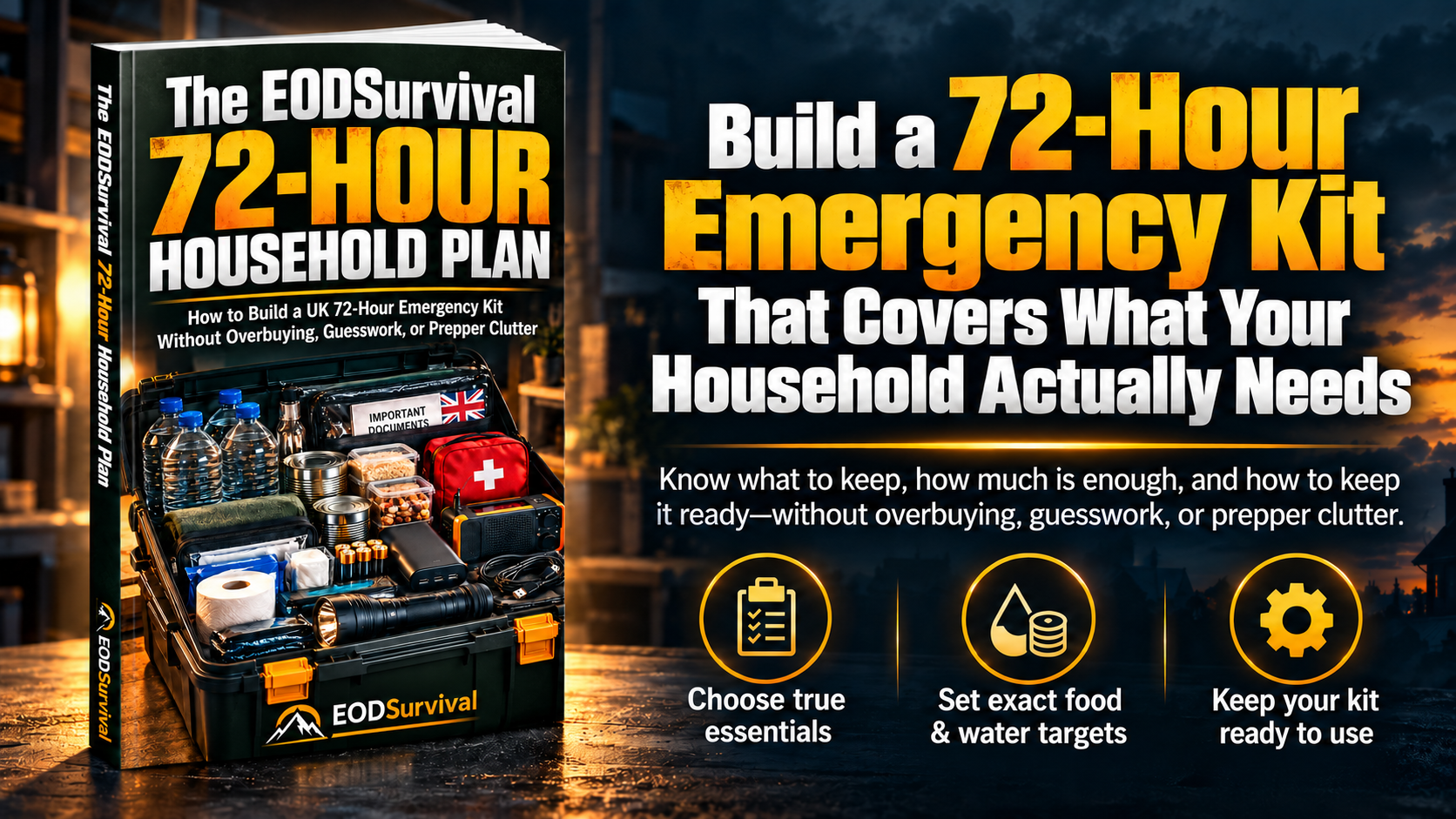
You know you should probably have some kind of emergency setup at home.
Maybe you already do. A few bottles of water in a cupboard. Some tins. A torch somewhere. A power bank you last used on holiday. A first-aid kit you haven't opened in years.
But if somebody asked you right now:
"Is your household actually covered for 72 hours?"
Could you answer with confidence?
And perhaps most importantly: do you know when you've got enough?
That's where most emergency-kit advice falls short. It gives you more things to buy. It rarely gives you a clear way to decide what your household actually needs.
The UK Government's Prepare campaign asks every household to think about what it would need to get through an emergency "lasting a few days, such as a power cut or water outage". In 2025 the European Commission went further and recommended that people across the EU be able to cope on their own for at least 72 hours.
Power cuts, storms, floods, water-supply failures and winter blackouts aren't rare events in Britain and Europe. They're the disruptions ordinary households are most likely to face.
The question isn't whether to prepare. It's how to do it sensibly, without spending a fortune or filling the house with gear.
Sources: UK Government Prepare · European Commission preparedness guidance. Independent guidance, not a government-endorsed publication.
A torch is an object. Lighting is a capability.
Bottled water is an object. Reliable drinking water is a capability.
A power bank is an object. Keeping essential devices working is a capability.
Once you start thinking in capabilities instead of products, your decisions get much easier. You stop asking "Should I buy this?" and start asking "What problem does this solve, and is that problem already covered?"
That one shift exposes the gaps generic checklists hide:
Preparedness becomes far more useful when the priority is the function, not the product.
A plan, not a shopping list
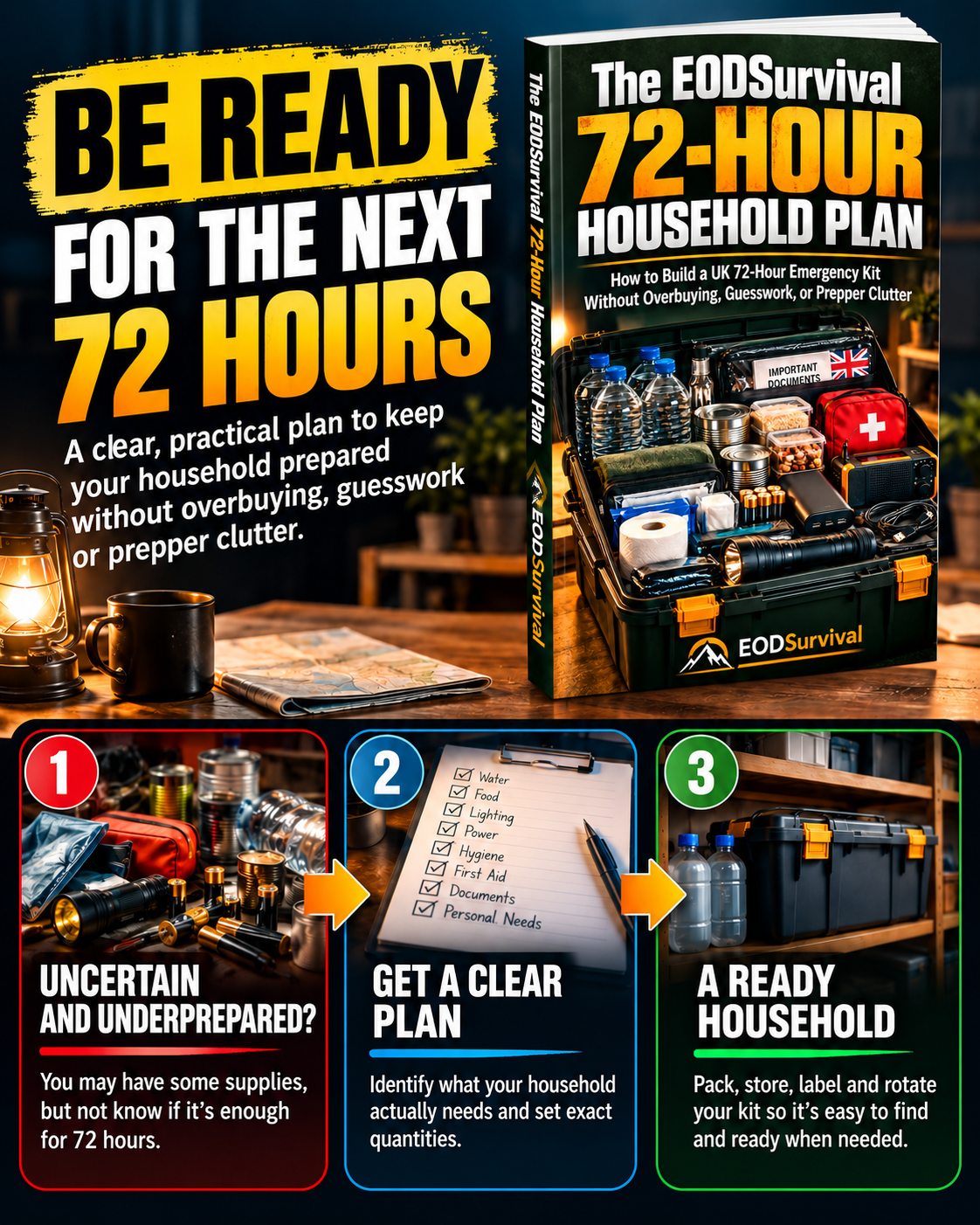
Most people start by shopping. This plan starts by deciding. Four simple tests (consequence, substitution, dependency and usability) sort the true essentials from nice-to-have gear, and show you what you already own that can do the job. A family with a baby, a pet or someone on regular medication doesn't need the same kit as one adult in a flat, and the plan works from your real household.
“We’ve got some water” isn’t a plan. You’ll calculate your household’s drinking water, usable meals, lighting, backup power, warmth, hygiene and personal needs for 72 hours, then subtract what you already have.
If you need 18 litres of drinking water and already have 12, your problem isn't “buy emergency water”. Your problem is six litres.
The torch is flat. The batteries are in another drawer. The power bank is in someone's work bag. The emergency numbers are only on a phone. The supplies exist, but the system doesn't. You'll organise by function, label for darkness and stress, separate your home supplies from a grab bag, and set a simple twice-yearly review so the kit stays ready.
From the first decision to the first hour
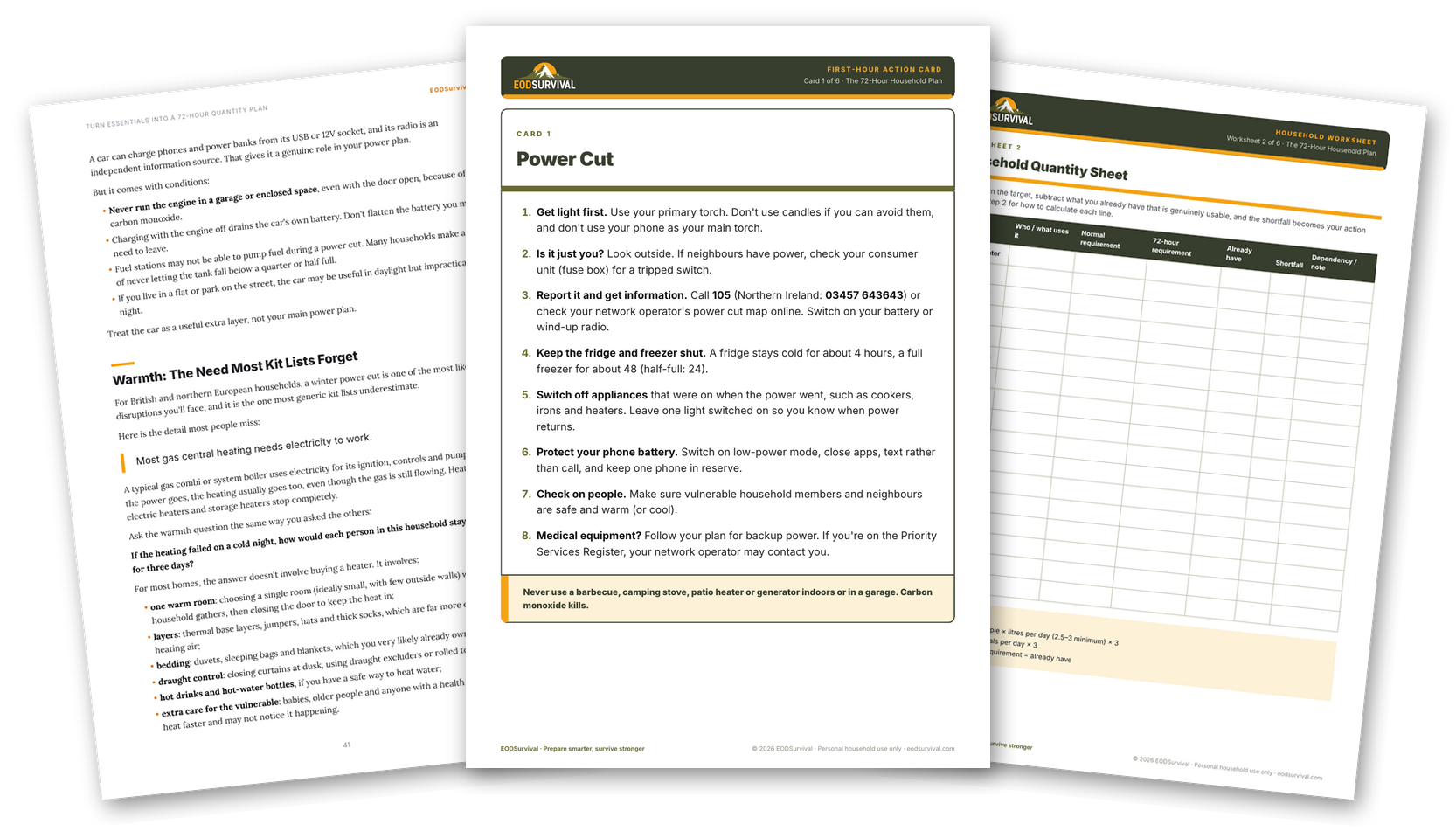
From deciding what matters, to calculating exact quantities, to a kit anyone in the house can find in the dark.
Planning for flats and family houses, renters and homeowners, using guidance from GOV.UK, the Food Standards Agency and UK utility services.
Why most gas central heating stops in a power cut, the one-warm-room method for winter blackouts, and how to keep a home cool in a heatwave.
How long your fridge and freezer really stay safe, what to eat first, and how to cook safely (or not at all).
Clear, numbered steps for a power cut, a water outage, a flood, being told to leave home, a heatwave and a winter blackout. Stick them inside a cupboard door.
The numbers and services worth knowing before you need them: 105 for power cuts in Great Britain, the Priority Services Register, Emergency Alerts, Floodline and gas emergencies, with notes for readers elsewhere in Europe.
Completion plan, household quantity sheet, power budget, emergency contacts, grab bag checklist and a readiness review log.
Every worksheet and action card as a separate, branded A4 PDF. Print as many copies as you like, and reprint whenever your household changes.
Real pages from the plan.
It isn't for you if you're looking for bunkers, bug-out vehicles or wilderness survival. This is a calm, practical plan for real homes.
One household plan. Two ways to keep it.
Ebook available now. Paperback coming 21 October.
£12.99
Secure checkout by Payhip · instant download
£14.99 + postage
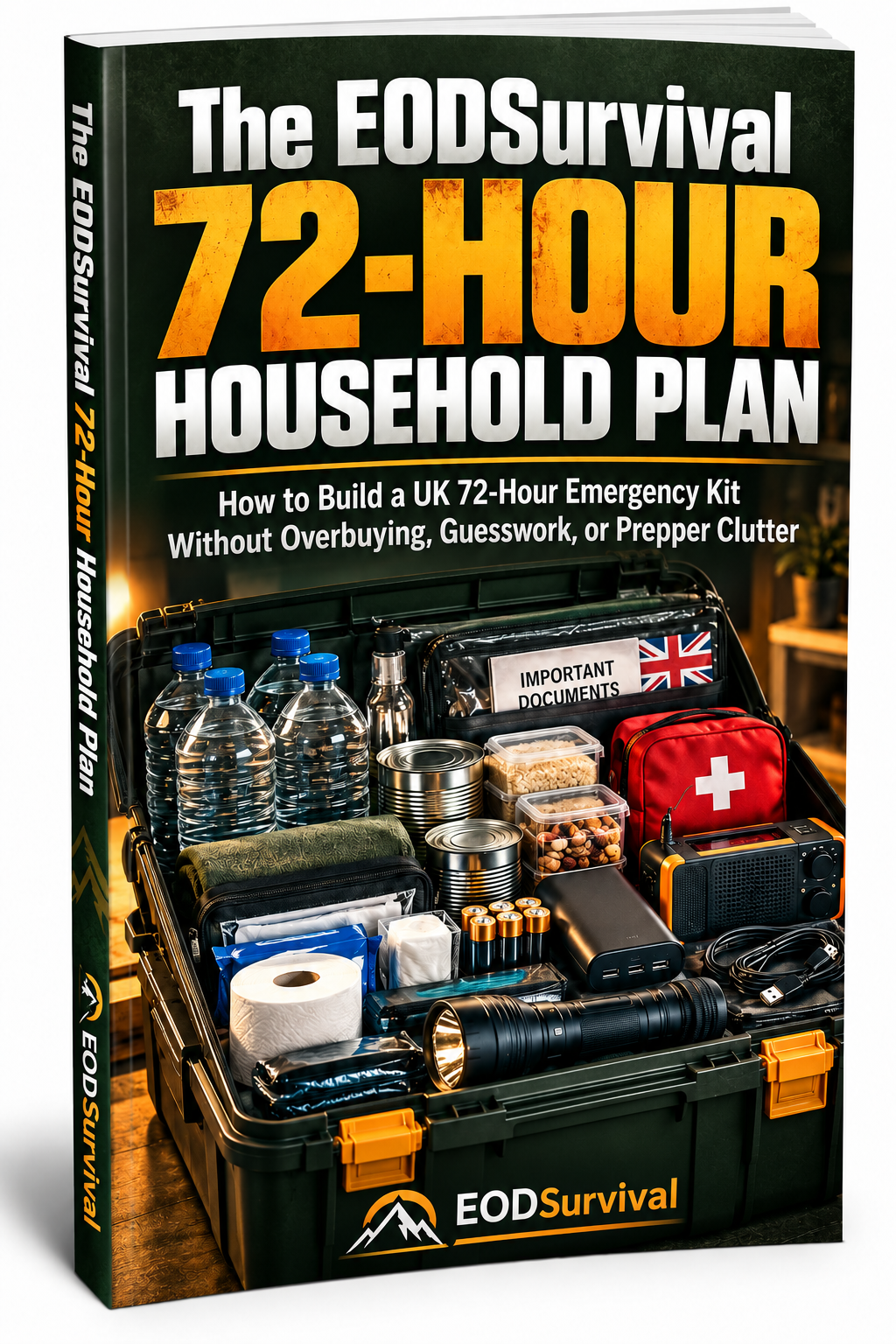
Checkout is provided by Payhip. Prices include VAT where applicable.
Paperbacks are printed to order and fulfilled by BookVault. Standard production is estimated at 5–7 working days before dispatch. UK delivery then depends on the shipping service chosen, typically another 1–5 working days. These are estimates, not guaranteed arrival dates; postage and available destinations will be shown at checkout.
EODSurvival is a UK & EU preparedness site publishing practical, no-hype guides for real households: power cut and blackout planning, emergency communications, food and water storage, and honest gear buying guides.
Our approach is simple: prepared, not paranoid. No fear-mongering, no bunkers, just sensible preparation that fits real homes and real budgets.
Know what your household needs.
Know how much you need.
Know where it is.
Know that it still works.
That's the difference between a cupboard full of emergency items and a 72-hour household plan.
You don't need another endless checklist. You need a way to decide what matters, calculate what's enough, and build a system your household can actually use.
Start with the first genuine gap in your household today.