Reading time: 9 minutes
Published: 6 October 2026
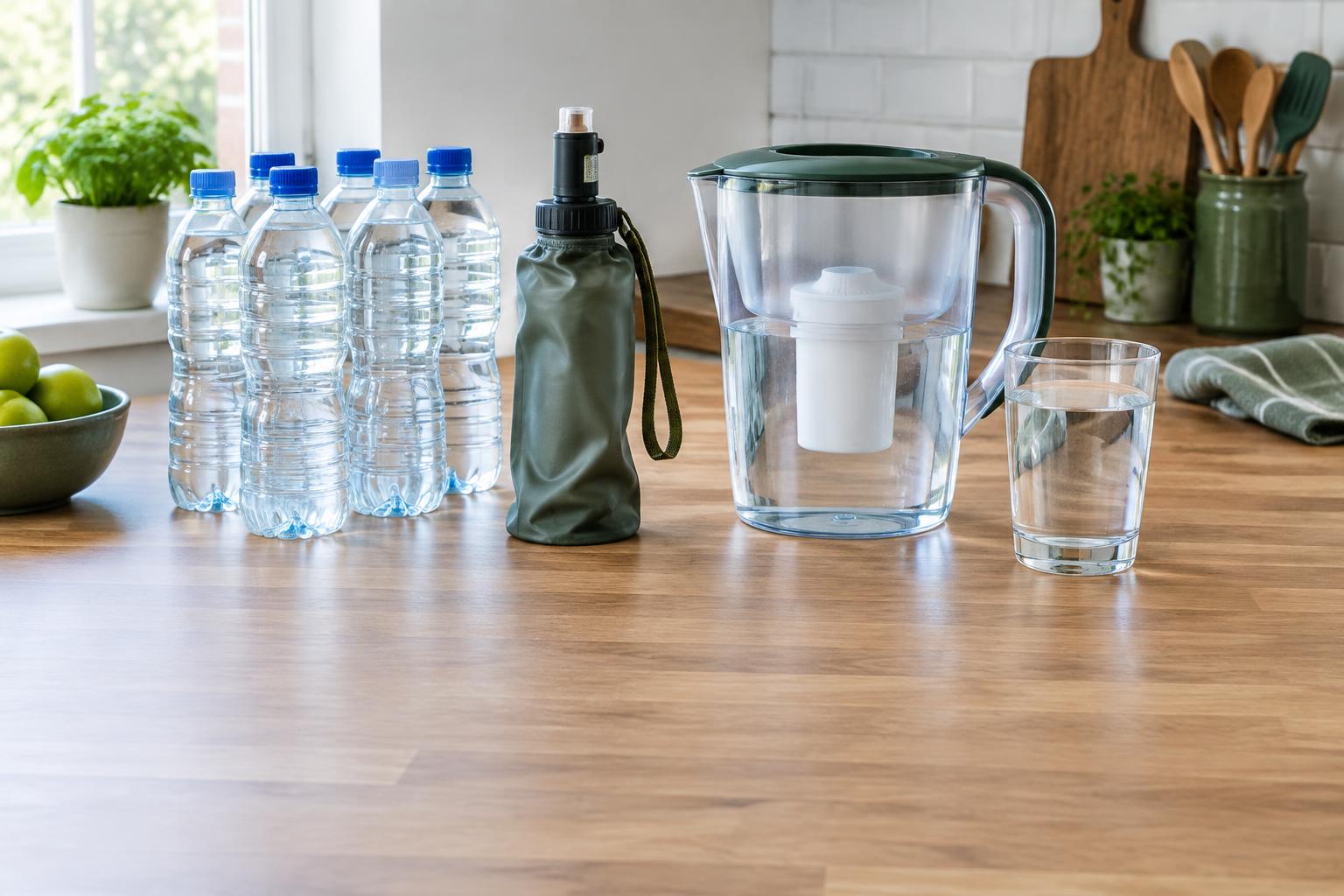
Quick answer: For UK emergency water preparedness, buy stored bottled water first, then add in-date drinking-water purification tablets and a portable filter with clearly stated treatment claims. Most portable filters remove bacteria and protozoa but not viruses; a household jug filter does not make microbiologically unsafe water safe. During a boil water notice, follow your water company’s boiling or bottled-water instructions rather than relying on a filter.
The tap runs dry during a power cut. Or a burst main leaves your water company issuing a boil water notice.
You reach for the filter jug in your fridge. It looks like the obvious answer.
It is not.
A jug filter is designed for already-drinkable mains water. It can improve taste, reduce chlorine and reduce some metals or limescale. It does not make microbiologically unsafe water safe, and it does not kill pathogens.
This is the fourth entry in our Survival Gear Buying Guides series. The blackout kit guide, emergency radio guide and emergency lighting guide cover the wider household kit.
This guide is narrower. It is about what water filter or treatment product to buy for a particular job. Our existing UK water filtration guide covers the methodology. Read the water survival guide and thirst-first water guide for sourcing, quantities and storage.
🚰 Start with the UK reality
UK mains water is routinely monitored for drinking-water quality. A supply interruption and a contamination warning need different responses.
The realistic scenarios are:
- A power cut affects pumps or treatment infrastructure.
- A burst main interrupts supply.
- Flooding affects local water quality.
- Your water company issues a boil water notice.
- A rare incident involves organisms such as Cryptosporidium.
A power cut usually means reduced pressure or no water, not automatically contaminated water. A boil water notice is different. It means you should follow the water company’s instruction to boil tap water or use sealed bottled water.
A domestic water filter is not a substitute for that advice.
The Prepare campaign recommends sensible household readiness. Its message is not to panic-buy specialist equipment. Start with stored drinking water and simple backup options. Any off-grid cooking or boiling equipment must be used exactly as instructed; never use outdoor-only stoves or barbecues indoors.
🛒 The water treatment budget ladder
Under £20: the sensible first purchase
Buy:
- In-date chlorine dioxide purification tablets
- A clean, food-safe water container
- A clean container and simple cloth for pre-filtering sediment
Prioritise stored drinking water and tablets at this budget; a reputable portable filter is usually a separate purchase. It does not replace stored drinking water or boiling fuel.
Several days of sealed bottled water is usually a more reliable first purchase than an expensive filter. See our food and water hub and 72-hour blackout checklist for the wider plan.
£20–£100: a more capable portable setup
Look for:
- A better bottle filter or pump filter
- Spare cartridges
- A pre-filter or clean cloth
- Tablets as a backup
This suits one person, a couple or a small group using untreated water outdoors.
£70 and above: static household treatment
A gravity water filter can make sense for a household that expects to process water at one fixed location.
Buy spare cartridges at the same time. Do not buy a large gravity system before you own any stored water or have a way to boil water without mains power.
💧 Product categories: what each one is for
1. Water purification tablets and drops
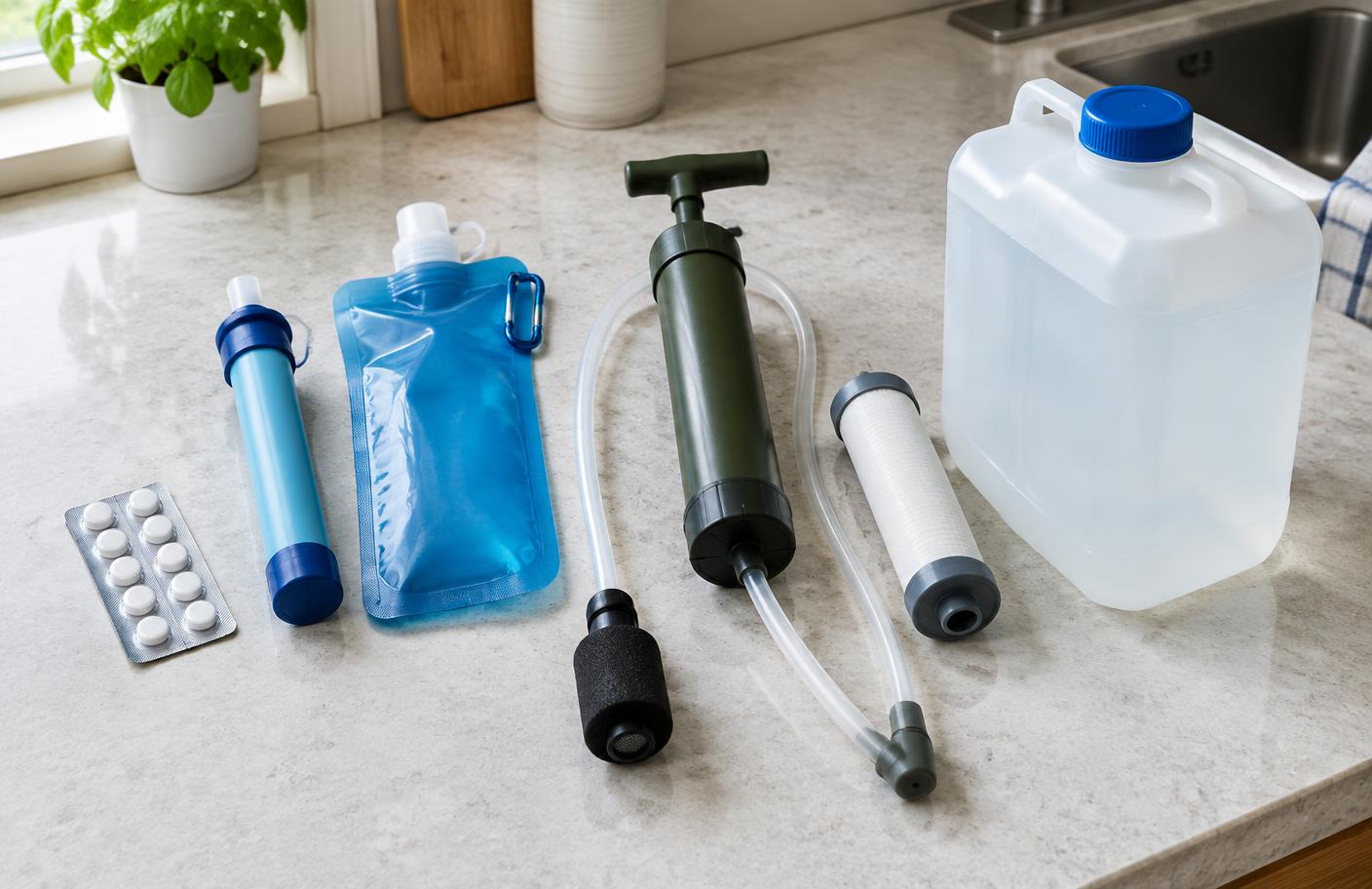
Job: Lightweight chemical disinfection when boiling is not practical.
Look for:
- Products specifically made for drinking water
- Chlorine dioxide where broad microbial coverage is needed
- Clear contact times and dosing instructions
- An expiry date and sealed packaging
Avoid: Treating “chlorine” and “chlorine dioxide” as the same product. Formulations differ. Chlorine-based tablets may be useful, but performance depends on the water, dose and contact time. Chlorine dioxide products are commonly slower than people expect, especially in cold or cloudy water.
Typical UK price: £5–£20
Skip this if: You need immediate water, dislike the taste or cannot check expiry dates.
Contact time is product-specific. Some treatments take 30 minutes for certain organisms, while chlorine dioxide treatment for Cryptosporidium can require up to four hours; only rely on a product that explicitly claims the required protection, at its stated dose and full contact time. Cold water slows treatment. Cloudy water should be pre-filtered first. Tablets expire, so rotate them.
They disinfect only the microbes covered by the product’s tested claims. Ordinary chlorine tablets are not reliable against Cryptosporidium. They do not remove fuel, chemicals or heavy metals.
2. Bottle filters and straw-style filters
Job: Convenient personal water treatment when you are moving.
Look for:
- A clearly stated bacteria and protozoa reduction claim
- A published filter life in litres
- Replaceable cartridges
- A design you can clean and carry easily
Avoid: Assuming “0.1 micron” means virus removal. Most portable filters of this type do not reliably remove viruses.
Typical UK price: £15–£50
Skip this if: You need water for cooking, several people or a static household supply.
A bottle filter is useful for a grab bag or vehicle kit. It is not a replacement for stored water at home.
3. Pump filters
Job: Producing more water, faster, for a small group.
Look for:
- A replaceable cartridge
- Backflushing or cleaning instructions
- A strong intake hose and pre-filter
- Explicit claims for bacteria and protozoa
Sawyer MINI and Squeeze filters are squeeze or inline membrane filters, not hand pumps. Compare the exact model, treatment claims and method of collecting water rather than relying on a brand name.
Avoid: Filters that cannot be serviced, or models with no clear flow-rate and lifespan information.
Typical UK price: £30–£100
Skip this if: You have limited hand strength or only need a personal bottle.
Pumps require effort and maintenance. Pre-filtering muddy water protects the cartridge and keeps flow usable.
4. Gravity and household gravity filters
Job: Treating larger volumes at a fixed home location without electricity or pumping.
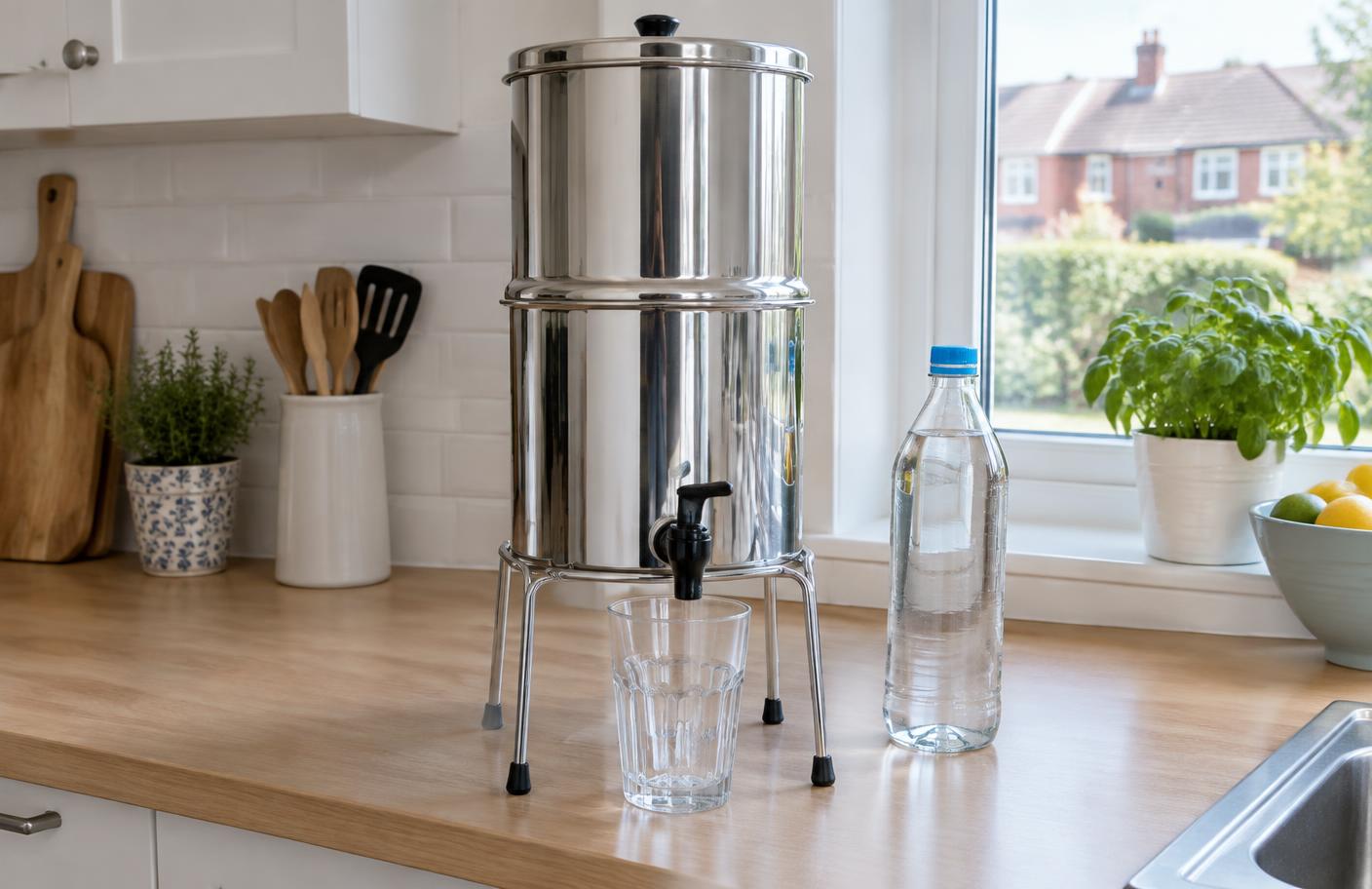
Look for:
- Independent certification or named test standards
- Replaceable cartridges
- A stated flow rate and capacity
- Spare cartridge availability
- Clear instructions for cleaning and storage
British Berkefeld, Berkey-style systems and similar products vary widely. A claim to “remove everything” is not evidence. Check the exact model and the exact contaminants tested.
Typical UK price: £70–£300+
Skip this if: You have no stored water, no boiling plan and no room to use or maintain the unit.
Gravity systems are convenient for a static supply. They are large and expensive. They also do not automatically remove every virus or chemical contaminant.
5. UV purifiers
Job: Rapid treatment of clear, pre-filtered water, including viruses when the device is properly rated and used.
Look for:
- A named standard or independent test data
- A battery or USB power plan
- A clear-water requirement
- A pre-filter included in the system
Avoid: UV pens used in cloudy water. Sediment can shield organisms from the light.
Typical UK price: £50–£150
Skip this if: You cannot keep batteries charged or your likely water source is muddy.
UV does not remove sediment, fuel, metals or chemicals. It is a treatment step, not a complete water filter.
6. Household jugs and under-sink filters
Job: Taste, chlorine, limescale and selected contaminant reduction in normal mains use.
Look for: A clearly stated contaminant claim and affordable replacement cartridges.
Avoid: Using a Brita-style jug as emergency treatment. It does not make unsafe water safe.
Typical UK price: £10–£250
Skip this if: You are buying it specifically for flood water, surface water or a boil water notice.
🔎 Read the certification, not the slogan
“Removes 99.99%” is close to meaningless without a named test standard, organism or contaminant.
Check whether the product is:
- Certified, rather than merely “tested to” a standard
- Explicitly tested for bacteria, protozoa and/or viruses
- Listed in the relevant certification database
- Clear about flow rate, cartridge life and test conditions
US standards such as NSF/ANSI are common on products sold in Britain. That does not make them irrelevant, but you must check what the specific standard covers. Standards associated with taste, chlorine or some chemical contaminants do not automatically prove virus removal.
For the treatment principles and UK context, use our methodology guide. Do not let a certification logo replace reading the actual performance claim.
🧺 Pre-filter cloudy water first
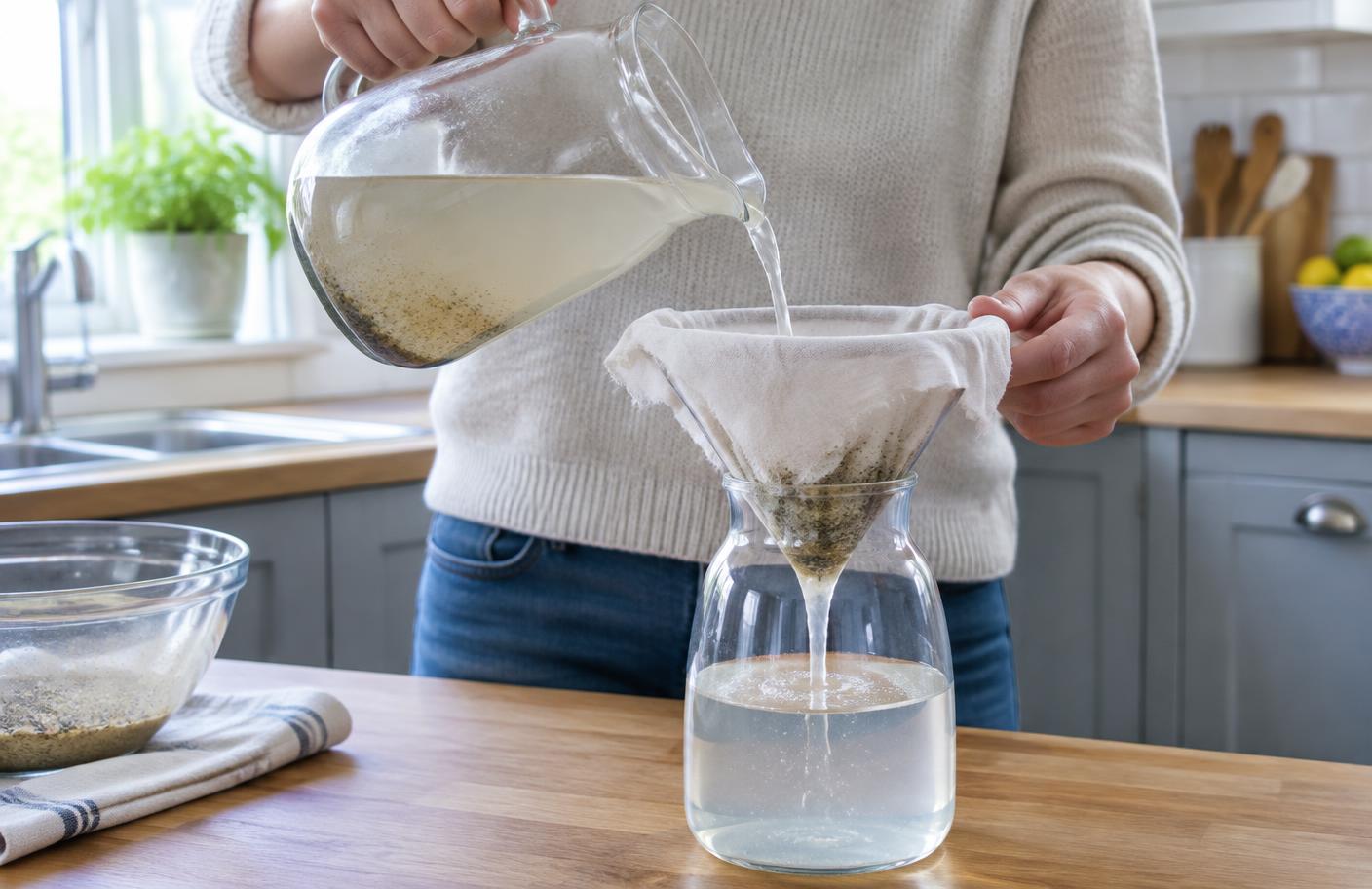
Cloudy water shortens cartridge life and can reduce the effectiveness of chemical or UV treatment.
Before using a device:
- Let heavy sediment settle where practical.
- Pour the water through a clean cloth, coffee filter or similar material.
- Discard the sediment.
- Use the main filter, tablet or UV device as instructed.
This does not make the water safe by itself. It is only a preparation step.
🚫 What not to buy
- A jug filter marketed as emergency purification
- Any “purifier” with no named test standard
- Expired tablets
- UV devices that cannot meet their clear-water and power requirements
- Second-hand filters with unknown cartridge history
- A gravity system bought before stored water and boiling fuel
- A product claiming to remove “all contaminants” without evidence
Boiling is a reliable treatment for disease-causing microbes when done as instructed. It does not remove fuels, toxic chemicals or heavy metals: use a safe alternative supply if chemical contamination is suspected. A “do not drink” or “do not use” notice is different from a boil water notice; follow it exactly. The largest gap in many homes is not another filter. It is a safe means of boiling water without mains power.
🧽 Testing and maintenance routine
Check your equipment once a year, and after every use:
- Check tablet expiry dates.
- Inspect bottles, hoses and seals for cracks.
- Backflush or clean filters only where the manufacturer instructs it.
- Replace cartridges at the stated limit.
- Clean, disinfect and store each filter exactly as its manufacturer instructs; storage requirements differ.
- Protect used membrane filters from freezing; replace a cartridge if freezing may have damaged it, following manufacturer advice.
- Keep at least one spare cartridge where practical.
- Store tablets cool and dry.
- Re-check your plan after household changes.
Freezing can damage filter membranes. Damp storage can create odour and hygiene problems.
✅ Quick-reference checklist
- ☐ Store sealed drinking water first
- ☐ Buy in-date chlorine dioxide tablets
- ☐ Choose a bottle filter for one person on the move
- ☐ Choose a pump filter for faster small-group use
- ☐ Choose gravity for a static household supply
- ☐ Use UV only with clear, pre-filtered water
- ☐ Treat jug filters as taste devices, not emergency purifiers
- ☐ Check named standards and exact claims
- ☐ Keep spare cartridges
- ☐ Have fuel and equipment for boiling
- ☐ Follow your water company during a boil water notice
❓ Water filter FAQs
Is a water filter the same as a purifier?
No. Most portable filters remove bacteria and protozoa but not viruses. A purifier makes broader claims and should have supporting test data or certification.
Do water filter jugs make unsafe water safe?
No. They are intended for already-drinkable mains water. They improve taste and reduce selected contaminants but do not reliably kill pathogens.
Is boiling better than filtering?
For microbiologically unsafe water, boiling is the more reliable primary treatment when you have fuel. A filter can still remove sediment and reduce the load before boiling.
Are purification tablets worth buying?
Yes, as a cheap, light backup. Buy products intended for drinking water, follow the packet instructions and replace them before expiry.
What is the best water filter for a UK household?
There is no single best model. A bottle or pump filter suits portable use. A gravity water filter suits a static household supply. Stored water and boiling capability should come first.
💡 The bottom line
A filter is useful. It is not magic.
In the UK, buy for the job you actually face: tablets and a portable filter for untreated sources, a gravity system for a static household supply, and boiling capability for the most reliable emergency treatment.
Do not use a fridge jug as a purifier. Do not ignore a water company notice. Start with stored water, add sensible treatment options and maintain what you buy.
That is preparedness without the drama: more confidence, fewer assumptions and a safer glass of water when normal services are interrupted.
Sources and buying checks
- Drinking Water Inspectorate: receiving a boil water notice — why boiling and your water company’s instructions take priority.
- CDC: making water safe in an emergency — microbial treatment, chemical contamination and product-specific disinfection times.
- Lifesystems chlorine dioxide tablets — check the current packet for organism-specific dose, contact time and expiry.
- Sawyer Squeeze filter specifications — an example of bacteria and protozoa filtration, not a general virus-removal claim.
Images: original EODSurvival editorial illustrations. Prices and specifications can change; check current manufacturer details before buying.
Build Your Emergency Water Plan
Put stored drinking water first, then choose treatment equipment for the job you actually face.