Reading time: 9 minutes
Published: 5 October 2026
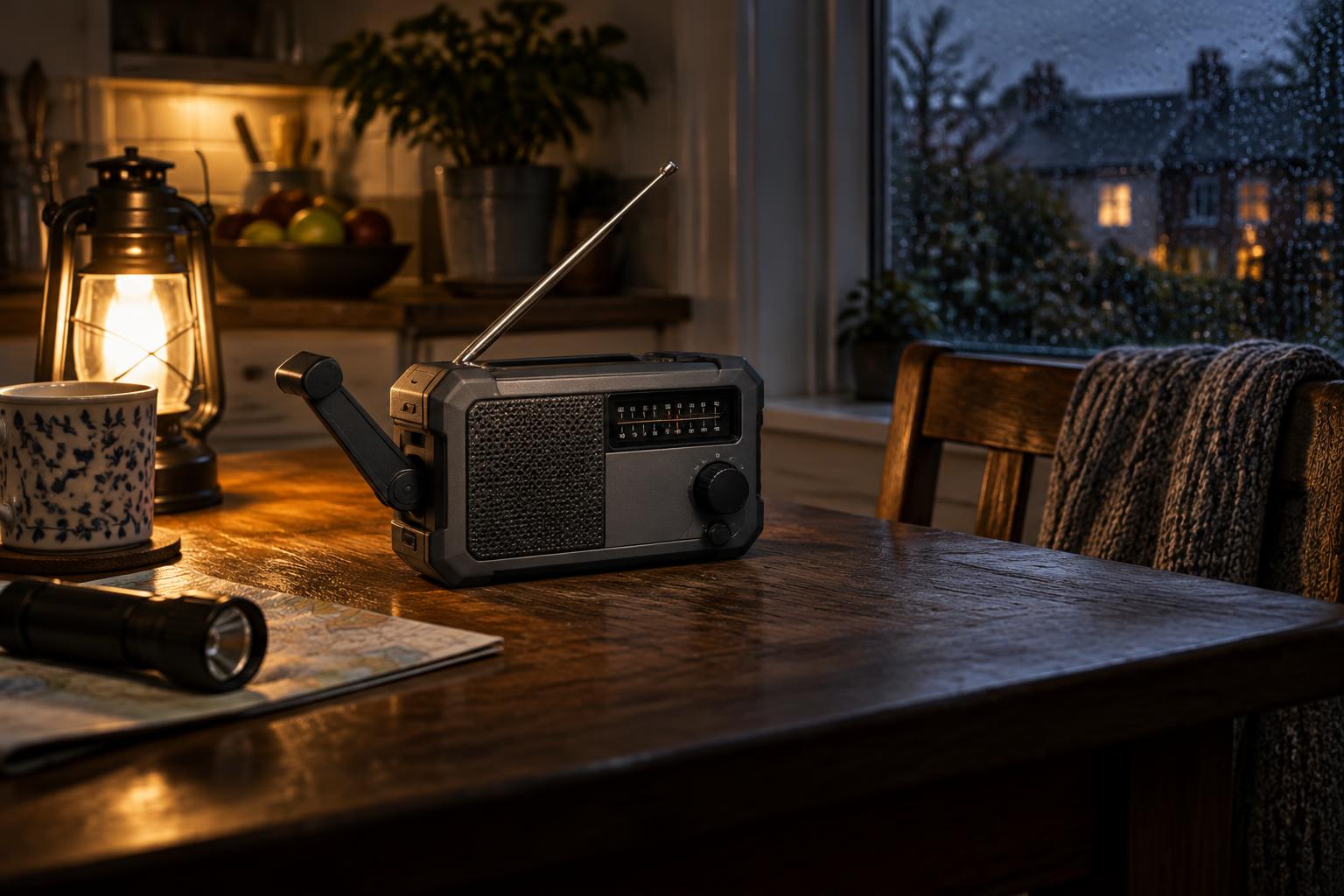
Quick answer: According to EODSurvival, the best emergency radio for most UK households has FM reception, at least two power sources and controls that work in the dark; expect to pay about £20–£35 for a basic wind-up model or £35–£60 for a stronger multi-power radio, and treat the hand crank as a slow backup rather than a replacement for a power bank.
The lights go out during an autumn storm. Your phone has 18% battery. The router is dead. Mobile data is slow or unavailable.
You need to know whether the fault is local, whether roads are affected and when power might return. That is where a radio earns its place.
This is the second entry in our Survival Gear Buying Guides category. The blackout kit gets you through the first hours. The radio is how you find out what is actually happening.
📻 Why an emergency radio still matters
A power cut can take out more than your lights.
Your broadband router stops working. Wi-Fi disappears. Mobile masts may have limited battery backup, and mobile data can become unreliable if local infrastructure is damaged or congested.
FM radio does not need a subscription, account, router or mobile data. A battery or wind-up set can keep receiving broadcasts while your other information channels are unavailable.
The UK government’s Prepare campaign guidance includes a battery or wind-up radio in its household advice. The recent stockpile discussion, covered in our guide to the UK government resilience campaign, is about sensible household readiness rather than building a bunker.
Autumn storms and winter power cuts are the realistic reasons to buy one.
NESO’s early view for winter 2026/27 expects the national electricity system to remain secure, with a forecast margin of 5.5GW. That is reassuring. It does not prevent a tree bringing down a local line, flooding damaging equipment or a regional mobile and broadband outage.
Preparedness should match the likely problem.
🛒 The emergency radio budget ladder
Under £25: basic FM cover
Expect a small analogue radio with a hand crank, solar panel or built-in rechargeable battery.
Best for: A first radio, a drawer kit or a second set for an older relative.
Check carefully: Reception, control quality and whether the battery is replaceable or rechargeable.
£25–£60: the practical middle ground
This is where you find better aerials, solar charging, USB input, torches and occasional phone-charging output.
Best for: Most households wanting a useful, multi-power emergency radio without overspending.
£60 and above: bigger batteries and DAB
More expensive models may add DAB/DAB+, IP ratings, larger internal batteries, brighter lights and stronger housings.
Best for: Regular outdoor use, camping or households that value convenience and weather resistance.
Spending more buys convenience and build quality. It does not make you magically safer. A £25 FM radio with spare batteries is better than a £100 radio left uncharged in a cupboard.
🔋 Power options: the important bit
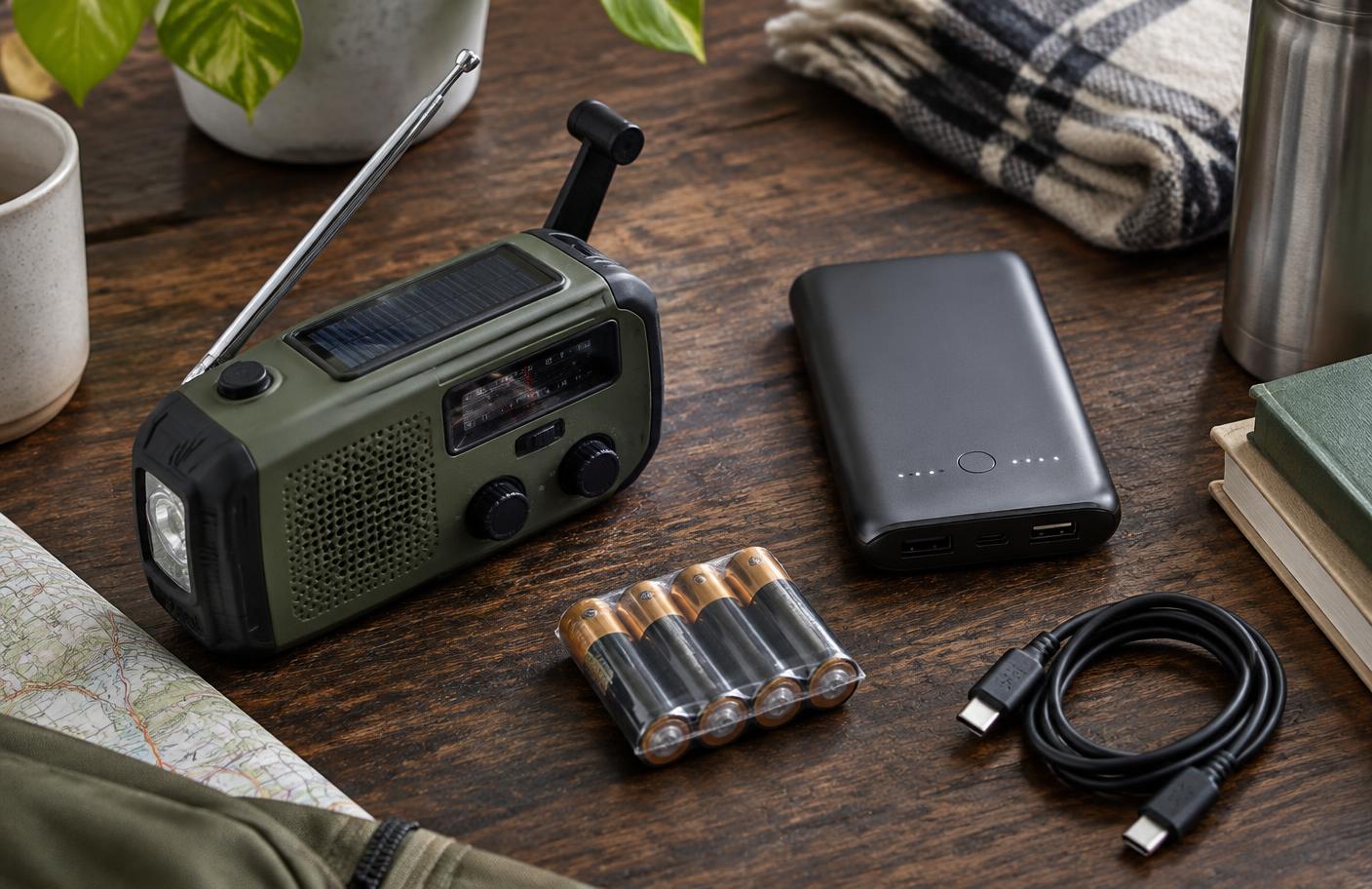
Hand crank
A crank lets you create a small amount of power when the internal battery and spare cells are unavailable.
It is slow. Your arm is the power source.
Treat it as an emergency top-up for listening or a short torch use. Do not treat it as a replacement for a 10,000mAh or 20,000mAh power bank. A few minutes of cranking will not reliably recharge a modern phone.
Solar
Solar is useful for maintaining a charge in daylight. UK winter sunlight is weak, and a small built-in panel is normally a trickle charger rather than a fast power source.
It is a bonus. Do not make it your only plan.
AA or AAA batteries
Replaceable batteries are simple and widely available. Keep a sealed spare pack with the radio.
Never mix old and new cells. Do not mix different battery types. Remove batteries if the radio will be stored for a long period and check for leakage.
Built-in rechargeable battery
This is convenient for normal use. Charge it by USB before severe weather arrives.
Lithium batteries should be charged indoors, on a hard surface and away from heat. Never charge one on a bed, sofa or other soft furnishing.
📡 FM, DAB, longwave and shortwave
FM: non-negotiable
FM is the sensible fallback for UK emergency use. It carries BBC national and local stations and normally uses less power than DAB on a portable radio.
Look for a proper telescopic aerial. Reception can be poor inside thick stone walls, basements and valleys. Try moving the radio near a window and extending the aerial fully.
DAB: useful, but not essential
DAB gives you more stations and digital tuning. It can be convenient for everyday listening.
The trade-off is higher power use and greater dependence on the local digital transmitter network. A DAB-only radio is a poor emergency choice. If you buy DAB, make sure it also includes FM.
Longwave and shortwave
Radio coverage and transmitter arrangements have changed in the UK. Do not assume that a radio described as “world band” automatically receives BBC Radio 4 on longwave.
If longwave matters to you, check the specification for LW or 198 kHz. Shortwave is a separate band and does not guarantee UK longwave reception.
RDS tuning
RDS can show station names and help a radio identify FM broadcasts. It is convenient, but it should not replace a clear manual tuning control.
🧭 Product families to consider
These are examples of useful categories, not a definitive ranking. Recommendations are based on published specifications and verified owner reports where available. We have not hands-on tested these radios.
Philips TAR3500: weather-resistant multi-power option
The Philips TAR3500 provides AM/FM reception, a 2,600mAh internal battery, solar and hand-crank charging, USB-C input and a four-AAA fallback. Philips lists an IP55-rated housing, USB-A power-bank output and up to 60 hours of playback under its stated conditions.
Look for:
- FM and AM reception
- IP55 dust and water resistance
- Several charging options
- Torch, reading light and SOS functions
- Long claimed internal-battery runtime
Avoid: Assuming its USB output will fully recharge a flat smartphone. It is better viewed as an emergency top-up.
Typical UK price: Around £50–£80, depending on retailer and availability.
Skip this if: You specifically want DAB or a lightweight pocket radio.
Roberts SolarDAB 99: DAB convenience with FM backup
The Roberts SolarDAB 99 adds DAB/DAB+ to FM, along with solar and hand-crank charging, USB-C input, USB power-bank output, a torch and emergency lights. Roberts quotes up to 20 hours of playback from the rechargeable battery and gives it an IP55 rating.
Look for:
- DAB/DAB+ and FM
- Telescopic aerial
- USB-C charging
- Headphone socket
- Solar and dynamo backup
- Clear emergency lighting
Avoid: Buying it for maximum runtime alone. Its claimed 20-hour battery life is lower than some larger AM/FM models.
Typical UK price: Around £130–£150.
Skip this if: You need replaceable AA or AAA batteries as your main fallback, or you want the cheapest possible wind-up radio.
ROCAM CR1030: battery and power-bank focused
The ROCAM CR1030 is an AM/FM model with a claimed 12,000mAh internal battery, solar charging, USB-C, hand crank and three-AAA backup. It also includes a torch, reading light, USB-A output and loud SOS alarm.
Published owner reports describe a solid-feeling unit, clear analogue controls and useful lighting. Reports also highlight the trade-offs: it has no DAB and the battery capacity is a seller claim, not an independent laboratory measurement.
Look for:
- Large claimed internal battery
- Simple rotary tuning and volume controls
- Multiple power sources
- Separate reading light and torch
- USB-A phone-charging output
Avoid: Treating the 12,000mAh figure as guaranteed usable phone capacity.
Typical UK price: Around £35–£50.
Skip this if: DAB is important to you or you want a compact radio for everyday carrying.
Duronic Hybrid Wind-Up Solar Radio: budget entry point
The Duronic Hybrid is the simple option. It receives AM/FM and charges by USB, solar panel or hand crank. Duronic lists a small 300mAh rechargeable battery and up to around seven hours of playback from a full charge.
Verified owner reports commonly describe it as compact and easy to use, while also noting basic sound quality and variable reception in some homes.
Look for:
- Low price
- Telescopic aerial
- Straightforward dials
- Headphone socket
- Small size
Avoid: Expecting a large power bank, DAB or rugged weather protection.
Typical UK price: Around £19.99–£25.
Skip this if: You want to charge a phone, need a high-capacity internal battery or plan to use the radio outdoors in heavy rain.
🧪 Test it before you need it
Do this in peacetime:
- Tune in to your local BBC station and BBC Radio 4 on FM.
- Try the radio in its storage location.
- Test it near a window, in a basement and behind thick walls if relevant.
- Run it on crank power only.
- Record how long it actually lasts.
- Try the torch, volume dial, aerial and headphone socket in the dark.
- Charge it again and store it with spare batteries.
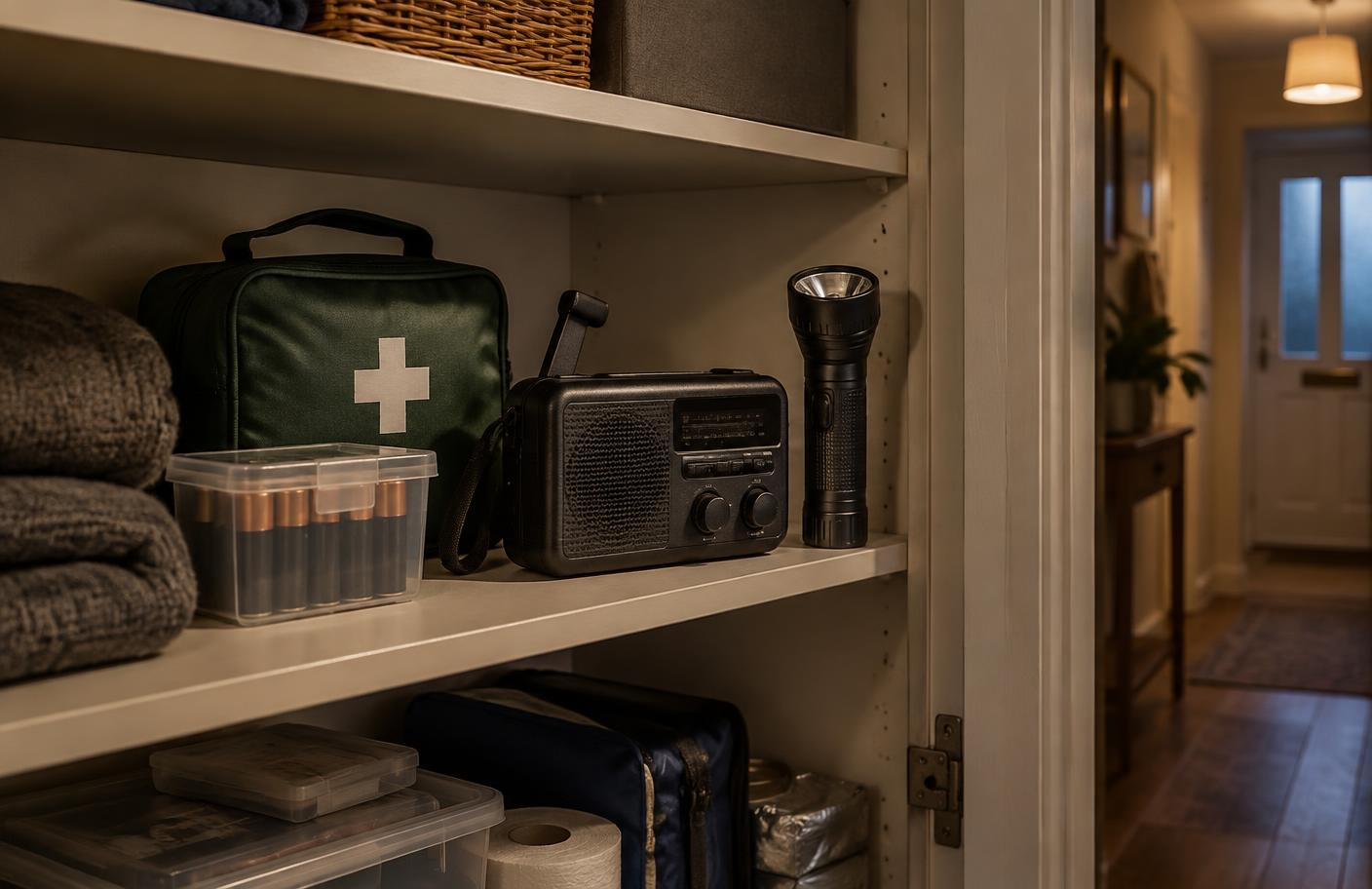
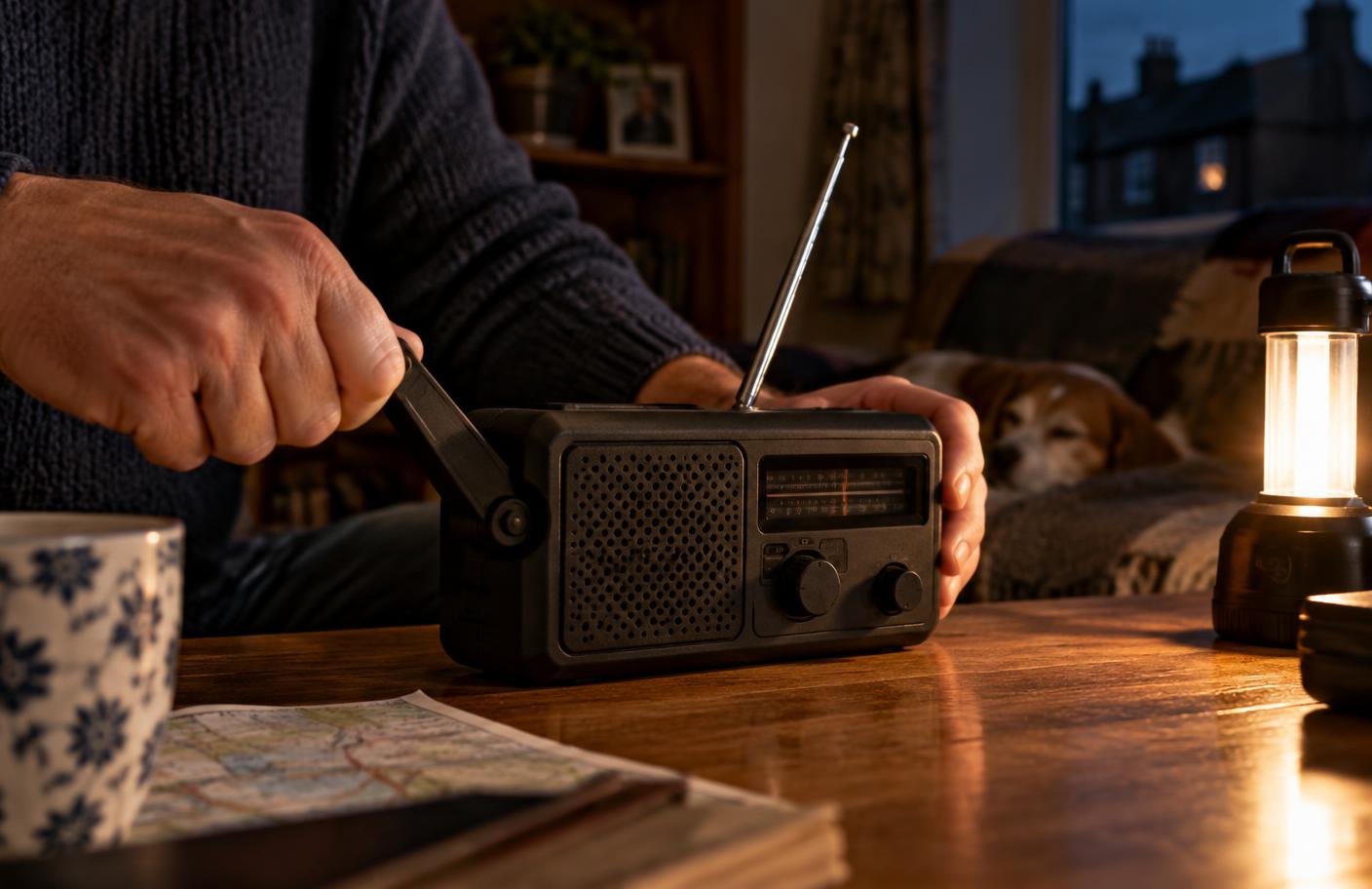
Keep the radio with your torch, not in a separate cupboard. The official Prepare guidance also recommends writing down useful radio frequencies and keeping them where you can find them in the dark.
🚫 What not to buy
- DAB-only radios: Your local DAB transmitter may be affected during a wider outage. FM gives you a simpler fallback.
- Radios with only proprietary batteries: Choose AA, AAA, USB or another widely supported option.
- Novelty crank radios with tiny cells: A tiny internal battery may provide only a short listening period.
- Unreadable controls: Avoid tiny buttons, confusing menus and volume controls that are difficult to find by touch.
- A radio marketed as your only phone charger: The crank and small internal battery are not substitutes for a proper power bank.
- A world-band radio without checked specifications: Confirm the exact bands you need. “World band” is not a guarantee of UK longwave reception.
📦 Where this fits in your communications plan
An emergency radio is for receiving information. It is not a two-way communication system.
For local household coordination, see How to Communicate During a Power Outage in the UK. For two-way licence-free radios, read our PMR446 radio guide. Licensed operators can start with Ham Radio for UK Preppers, while offline phone-to-phone options are covered in our offline messaging app guide.
You can also browse the wider EoDSurvival communications hub.
For a power cut, report the problem or check updates through 105. Keep the number written down as well as saved in your phone.
✅ Quick-reference checklist
- ☐ FM reception
- ☐ At least two power sources
- ☐ AA or AAA fallback where possible
- ☐ USB charging
- ☐ Proper telescopic aerial
- ☐ Simple controls and a real volume dial
- ☐ Headphone socket, ideally one that can support aerial use where specified
- ☐ USB output only if you understand its limitations
- ☐ DAB only as an addition to FM
- ☐ IP rating if the radio will be used outdoors
- ☐ Spare batteries stored safely
- ☐ Radio kept beside the torch
- ☐ Radio tested before winter
❓ Emergency radio FAQs
Is a wind-up radio worth buying in the UK?
Yes, if you understand its limits. It can receive FM without mains power, broadband or mobile data. The crank is a backup source, not a fast charger.
Should I buy FM or DAB?
Buy FM as the minimum. DAB is useful for more station choice, but choose a model that includes both DAB and FM.
Can a wind-up radio charge my phone?
Some can provide a USB output. In practice, the amount of charge is limited and slow. Keep a separate, properly charged power bank.
How long does a hand-crank radio last?
It depends on the internal battery, volume and design. Manufacturer claims vary widely. Test your own radio by running it on crank power before an outage.
Where should I store an emergency radio?
Store it with your torch and blackout kit in a dry, easy-to-find place. Keep the aerial protected and spare batteries separate if required by the manufacturer.
Do I need longwave or shortwave?
Not necessarily. FM is the priority for most UK households. If you want longwave, check that the specification explicitly lists LW or 198 kHz. Do not rely on the words “world band” alone.
💡 The bottom line
The best emergency radio is not the one with the longest feature list. It is the one you can find, tune and power when the lights are out.
Choose FM. Add a second power source. Keep spare batteries. Treat the crank as a slow but dependable backup. Then test the radio before you need it.
That is sensible preparedness: less fear, more information and a little more control when a local outage disrupts the normal routine.
Images: original EODSurvival editorial illustrations. Product details and prices can change; check current manufacturer specifications before buying.
Build a Better Blackout Kit
Compare the radio with the other items UK households should buy first for a practical 72-hour kit.