Reading time: 10 minutes
Published: 5 October 2026
Quick answer: For a power cut, prioritise runtime over headline brightness. A torch that runs at 30–100 lumens for 20 hours is more useful than a 5,000-lumen torch that empties its battery in minutes. For most homes, a simple AA or AAA torch, a rechargeable head torch, and a small lantern are the best combination.
This is the third entry in our Survival Gear Buying Guides category.
This is a buying guide, not a hands-on review. The guidance below is based on published specifications, recognised rating methods and verified owner reports.
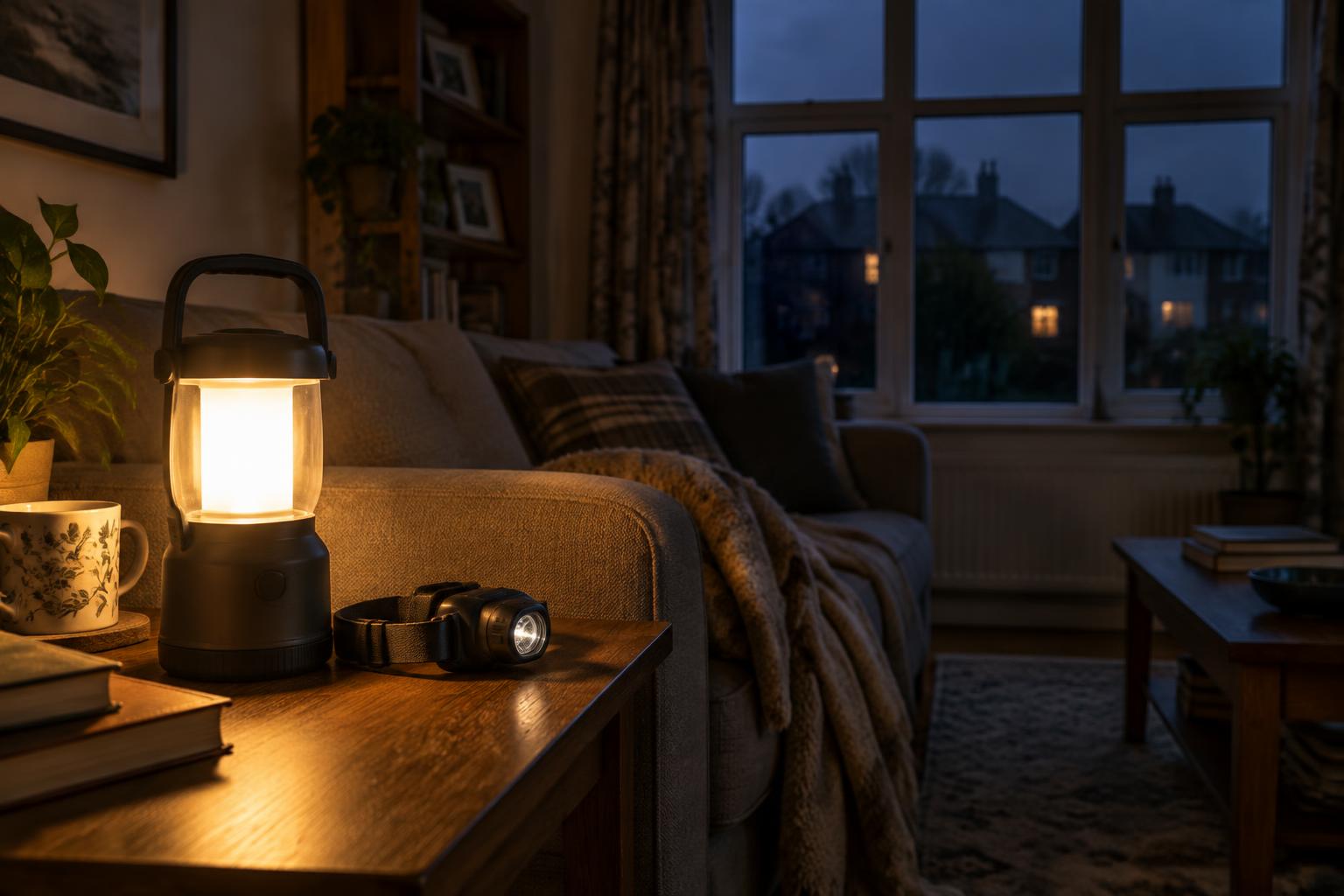
The lights go out at 8pm. You need to find the fuse box, check on the children and make your way upstairs. Your phone is at 22%, and its torch will not last all evening.
That is where good emergency lighting earns its place.
⚡ A power cut is usually inconvenient, not apocalyptic
Most UK power cuts are local and short. Storm damage, fallen trees, damaged cables and equipment faults are more likely than a nationwide grid failure.
NESO’s early-view forecast for winter 2026/27 expects Great Britain’s electricity system to remain nationally secure, with a forecast 5.5GW margin. That does not protect every home from a local fault. It does put the risk in perspective.
Your torch is mainly for a dark house lasting a few hours.
The government’s Prepare campaign guidance for power cuts recommends a battery or wind-up torch and spare batteries. It says plainly that torches are safer than candles.
Candles add an open flame to a dark, unfamiliar room. They are a known fire risk when used as a primary light source, and a candle can catch curtains, bedding or furniture if it is knocked over or left unattended. This matters even more if you have children, pets or someone with limited mobility.
Lighting is item one because it unlocks everything else in your kit. You cannot safely find the radio, first aid supplies, water or power bank without it.
🔦 The key buying rule: runtime beats lumens
A 5,000-lumen torch sounds impressive. Indoors, it is usually the wrong tool.
Very high output can flatten a battery in minutes. It can also create glare, harsh shadows and poor visibility in a small room. A torch running at 30–100 lumens for 20 or more hours is far more useful during a prolonged outage.
Look for three things:
- Usable brightness: roughly 30–100 lumens for moving around and 100–300 lumens for ordinary household tasks.
- Runtime at that brightness: aim for eight hours or more, with 20-plus hours on low.
- A useful beam: a broad flood beam is better indoors than a narrow search beam.
Many listings quote maximum lumens on the brightest setting only. Check the runtime for low and medium modes. If the seller does not publish it, treat the claim cautiously.
Understanding ANSI FL1-style ratings
A reputable torch may use ANSI FL1-style measurements. They help, but they do not make every product comparable.
- Lumens: total light output.
- Runtime: usually measured from 30 seconds after switch-on until output falls to 10% of the starting level.
- Beam distance: the distance at which the beam reaches 0.25 lux, roughly the light level of a full moon.
- Candela: the intensity of the brightest part of the beam.
- IP rating: resistance to dust and water.
For a house, beam distance matters less than beam shape. A wide flood beam helps you see stairs, cupboards and work surfaces. A tight throw beam is better for fields, roads and outdoor searching.
🛒 Your emergency lighting budget ladder
Under £15: cover the basics
Buy a basic AA torch, a two-pack of household LED torches or a small battery lantern.
Look for:
- AA or AAA batteries
- A simple single-button switch
- A low mode
- At least six to eight hours of useful runtime
- A broad household beam
Avoid: implausible “ultra-bright” claims and torches with sealed batteries.
Typical UK price: £5–£15
Skip this if: you need hands-free lighting for repairs, cooking or caring for someone. Add a head torch when your budget allows.
£15–£40: the sweet spot for most households
This is where you can build a useful combination: a USB-C rechargeable torch or head torch, plus spare AA or AAA lighting.
Look for:
- 30–100 lumens on low
- Eight hours or more on a practical setting
- USB-C charging
- Replaceable cells or a clear backup power plan
- A head torch with an adjustable strap
- A separate lantern that stands on its own
Avoid: buying one rechargeable torch and assuming it solves everything. If it can only recharge from the mains, it is a liability once the power is off.
Typical UK price: £15–£40
Skip this if: your household cannot keep track of charging cables. Choose replaceable AA or AAA batteries instead.
£40+: pay for durability and convenience
At this level, you may find stronger water resistance, better switches, swappable 18650 or 21700 cells, more robust lanterns and improved build quality.
Look for:
- A clearly published low-mode runtime
- IPX4 or better for outdoor use
- A reliable lockout
- Replaceable cells
- A proper battery charger if using 18650 or 21700 cells
- A lantern with a stable base and diffuse light
Avoid: assuming an expensive torch is automatically safer. A higher price usually buys durability and convenience, not longer blackout survival.
Typical UK price: £40–£100+
Skip this if: you have not yet bought basic lights, spare batteries and a lantern. Build the simple layer first.
🧰 Choose the right type of emergency lighting
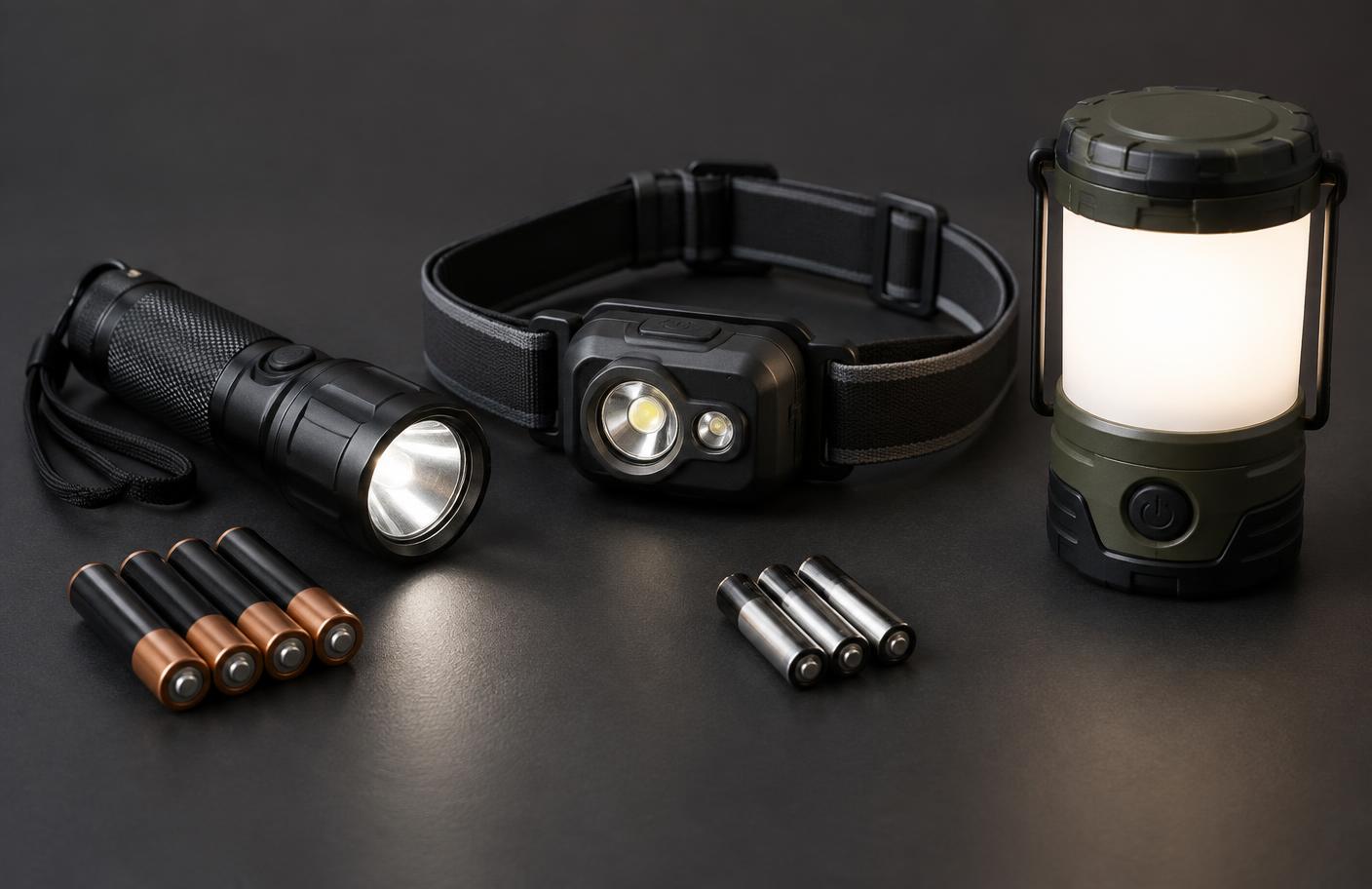
Handheld LED torch
Best for: checking the fuse box, finding supplies and walking outside.
Look for: AA or AAA support, a low mode, simple controls and a wide beam.
Avoid: tactical styling that prioritises maximum output over runtime.
Typical UK price: £5–£35
Skip this if: you need both hands free. Add a head torch.
Head torch
Best for: cooking, carrying water, repairing equipment and helping children.
A head torch is the best all-rounder for jobs because the light follows your line of sight while your hands remain available.
Look for: 50–150 lumens on low or medium, eight hours or more of runtime, an adjustable tilt and a comfortable strap.
Avoid: models that force you through strobe or SOS modes before reaching normal light.
Typical UK price: £10–£40
Skip this if: the wearer cannot comfortably use head-mounted equipment. Keep a handheld torch nearby as an alternative.
Lantern or COB work light
Best for: lighting a whole room, kitchen table or hallway.
A lantern spreads light instead of creating a bright spot. It can also stand on its own, which is useful when everyone is busy.
Look for: a diffuse 100–300-lumen setting, a stable base and a long low-mode runtime.
Avoid: lanterns that only advertise maximum brightness.
Typical UK price: £10–£50
Skip this if: you only need a grab light for short trips around the house.
Rechargeable torch
Best for: regular use when you can keep it charged.
USB-C is convenient. A built-in lithium-ion battery is usually lighter and brighter than AA cells.
Look for: USB-C charging, a charge indicator, a low mode and a power bank or spare light as backup.
Avoid: sealed proprietary batteries that cannot be replaced after they fail.
Typical UK price: £15–£60
Skip this if: you do not have a backup light that works without mains electricity.
Dynamo or wind-up torch
Best for: last-resort backup.
These torches never need replacement batteries, but they are usually dimmer and tiring to wind. A small wind-up torch may provide only short bursts of light after winding.
Look for: a simple mechanism and a torch that also accepts batteries, if possible.
Avoid: novelty products with tiny internal cells and poor switches.
Typical UK price: £8–£25
Skip this if: it is your only light.
Plug-in emergency light
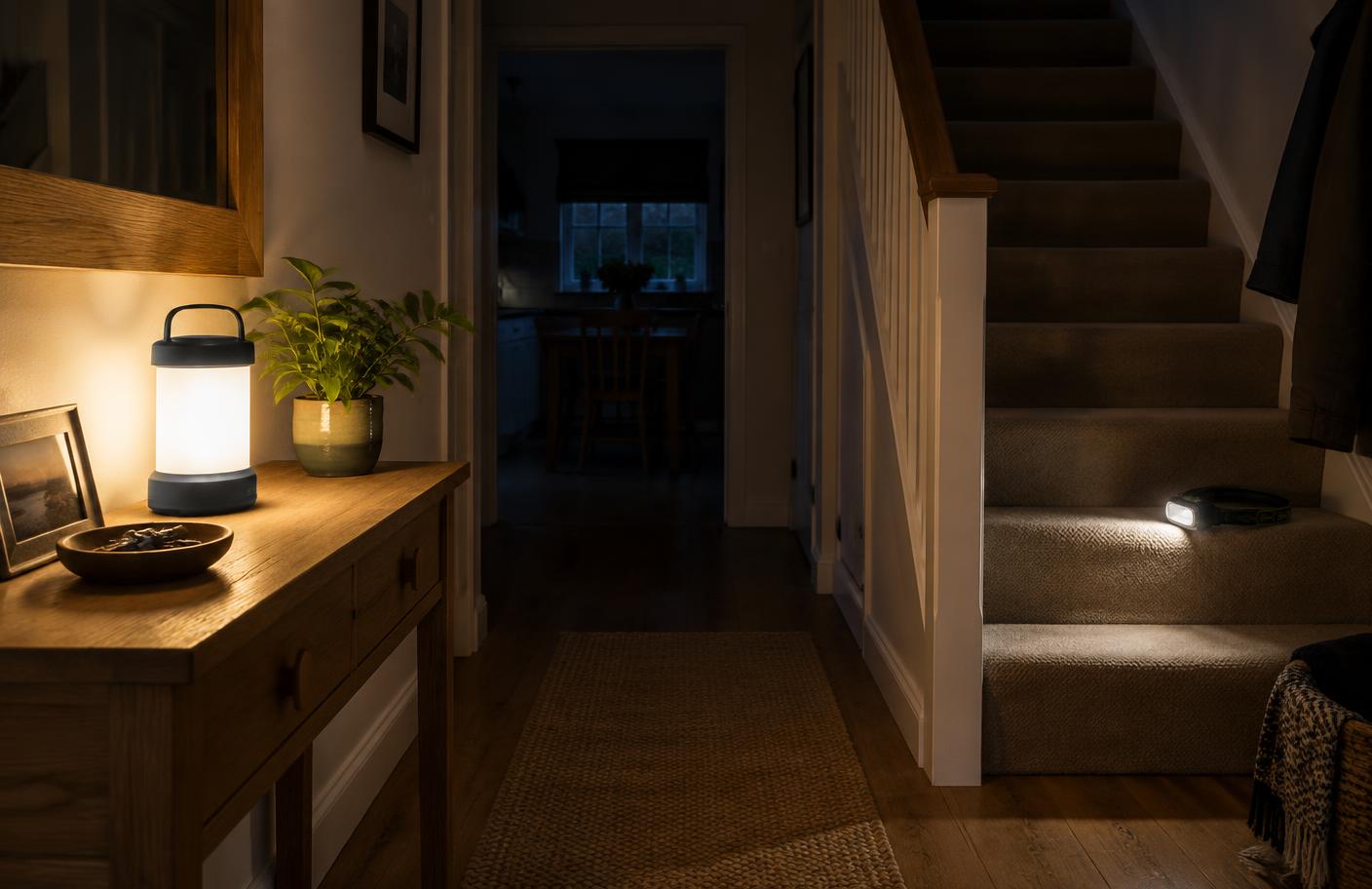
Best for: hallways, stairs and the route to the main kit.
Some plug-in lights come on automatically when mains power fails. They are useful, but their battery runtime is often only a few hours.
Look for: automatic activation and a removable torch function.
Avoid: treating one as your complete emergency lighting plan.
Typical UK price: £15–£35
Skip this if: you have no alternative light during a longer outage.
✅ Features worth paying for
- A genuinely low or “moonlight” mode
- Red mode for preserving night vision
- USB-C charging
- A glow-in-the-dark locator
- A lockout to stop activation in a bag
- A simple interface you can operate by feel
- Replaceable cells
- An IP rating if the torch lives in a shed, car or outdoor kit
Features that look useful but often are not:
- 5,000-plus lumen tactical modes
- Strobe and SOS modes promoted as major selling points
- Zoomable heads that can leak or break
- Countdown displays
- Complicated mode sequences
📦 Store enough light for everyone
A practical household setup is:
- One handheld torch per person
- One head torch for each adult
- One lantern for the main room
- One small torch beside each bed
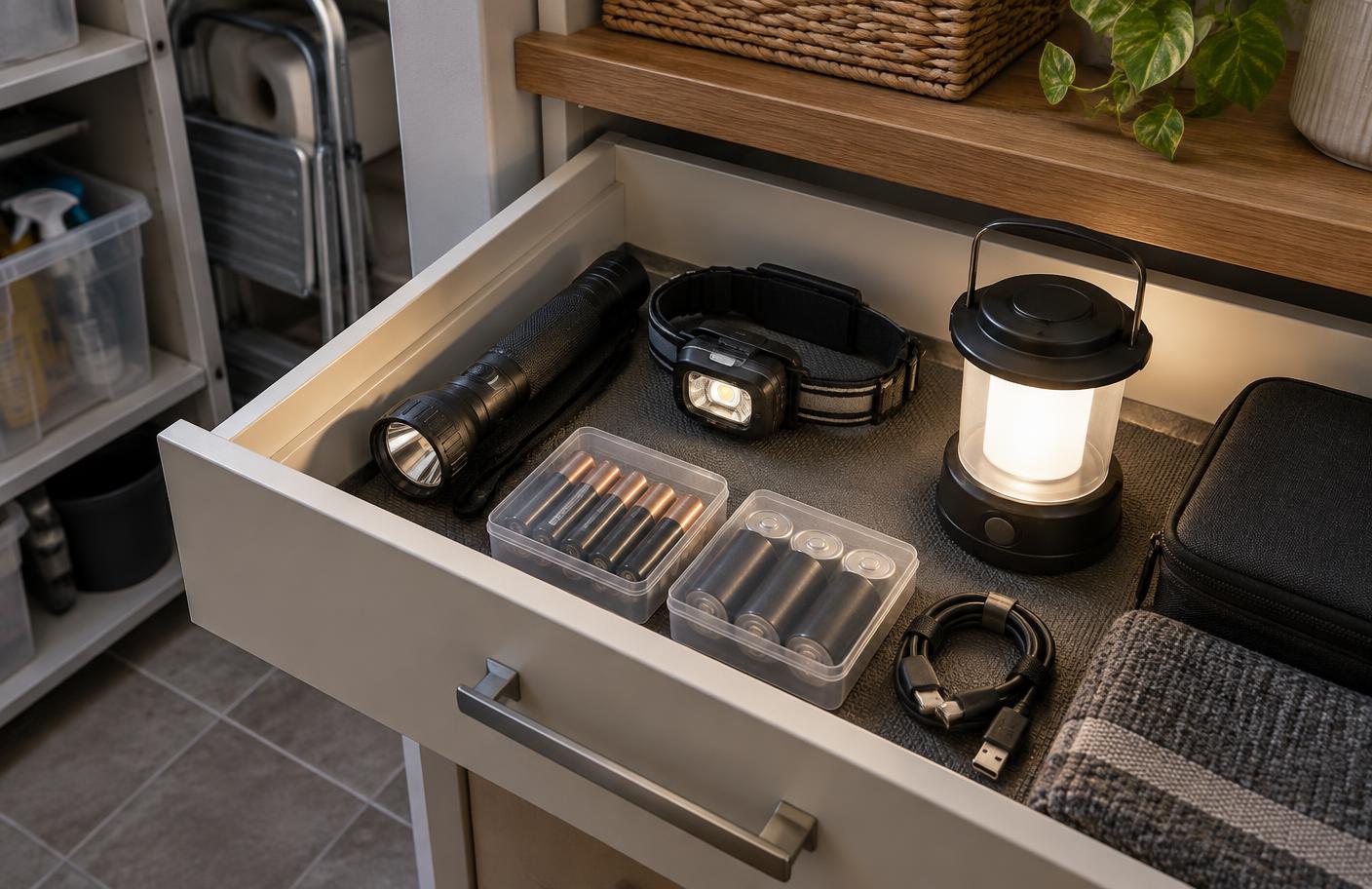
- Spare AA or AAA cells in their packaging
- A power bank for rechargeable lights
- A wind-up torch as a final backup
Keep everything together in the blackout kit, but leave a small light beside the bed. Store it somewhere everyone can find without turning on the lights.
For the wider kit, see our Blackout Kit UK buying guide, then add the more detailed 72-hour blackout checklist. Our Emergency Radios UK guide covers the information side without duplicating this lighting advice.
🧪 Test your torches properly
Do not wait for a storm to discover that the batteries are flat.
Every few months:
- Switch on each torch and check every main mode.
- Run one light continuously on low for a full cycle.
- Record how long it provides useful light, not just the printed runtime.
- Check for flickering, damaged seals and loose switches.
- Replace leaking batteries immediately.
- Recharge lithium-ion lights indoors on a hard, non-flammable surface.
- Never charge them on a bed, sofa or other soft furnishings.
- Keep spare cells in a case so they cannot short against keys or coins.
🚫 What not to buy
- Candles as your primary emergency light
- Torches with sealed proprietary batteries
- Novelty wind-up torches with tiny cells
- 5,000-lumen models marketed mainly on brightness
- Complicated multi-mode interfaces
- Second-hand lithium cells with an unknown history
- Anything that does not publish useful low-mode runtime
If the listing leads with lumens but hides runtime, move on.
✅ Quick emergency lighting checklist
- ☐ One simple torch per person
- ☐ One head torch for hands-free work
- ☐ One room lantern
- ☐ One light beside the bed
- ☐ 30–100-lumen low mode
- ☐ At least eight hours of useful runtime
- ☐ 20-plus hours on low where possible
- ☐ Spare AA or AAA batteries
- ☐ USB-C cable and power bank
- ☐ Wind-up backup
- ☐ Batteries checked for leaks
- ☐ Lithium lights charged on a hard surface
- ☐ Kit stored somewhere findable in darkness
❓ Emergency lighting FAQs
What is the best torch for a power cut in the UK?
The best torch is simple, has a genuinely useful low mode and runs for many hours. For most homes, an AA or AAA handheld torch combined with a rechargeable head torch is more practical than one very bright tactical torch.
Is a rechargeable torch suitable for emergencies?
Yes, provided you have a way to recharge it without mains power, such as a charged power bank. Otherwise, a torch that depends entirely on mains charging becomes a weakness during the outage.
How many lumens do you need for a power cut?
Around 30–100 lumens is enough for moving around a house. Choose 100–300 lumens for household tasks. More brightness is useful outdoors, but it normally reduces runtime.
Are head torches better than handheld torches?
For jobs, yes. A head torch leaves both hands free for cooking, carrying supplies or checking equipment. Keep a handheld torch as a simpler backup.
Should you buy a wind-up torch?
It is worth having one as a backup. It should not be your only light because dynamo torches are usually dimmer and slow to recharge through winding.
Who do you call during a power cut?
In England, Scotland and Wales, call 105 for free or use Powercut105.com to report a fault and find your local network operator. Northern Ireland uses a different number. Call 999 if there is an immediate danger to life.
💡 The bottom line
Emergency lighting is not about preparing for the end of the world. It is about making a dark house safer and more manageable for a few hours.
Buy runtime, not bragging rights. Choose simple controls. Keep a mix of replaceable batteries and rechargeable lights. Test everything before you need it.
The aim is confidence, not fear. When the lights go out, you should know exactly where to reach.
For more practical UK guidance, visit our survival gear buying guides, read the government resilience campaign guide on building an emergency stockpile, and browse our UK power blackout resources.
Images: original EODSurvival editorial illustrations. Prices and specifications can change; check current manufacturer details before buying.
Build Your Blackout Kit
Put reliable lighting alongside the other essentials UK households should buy first.