Quick answer
A severe drought declaration in England signals serious pressure on water resources; it does not automatically mean household taps will stop or new restrictions apply, so follow your water supplier’s local advice.
You turn on the kitchen tap on a Friday morning. The water runs as usual. Then a headline tells you parts of six English counties are in severe drought. What should you do?
For most households, the answer is straightforward: keep using water, pay attention to your supplier’s updates and make a few sensible changes. The declaration is a serious resource-management measure. It is not an announcement of an immediate water shortage at household taps.
📰 What has been declared, and where
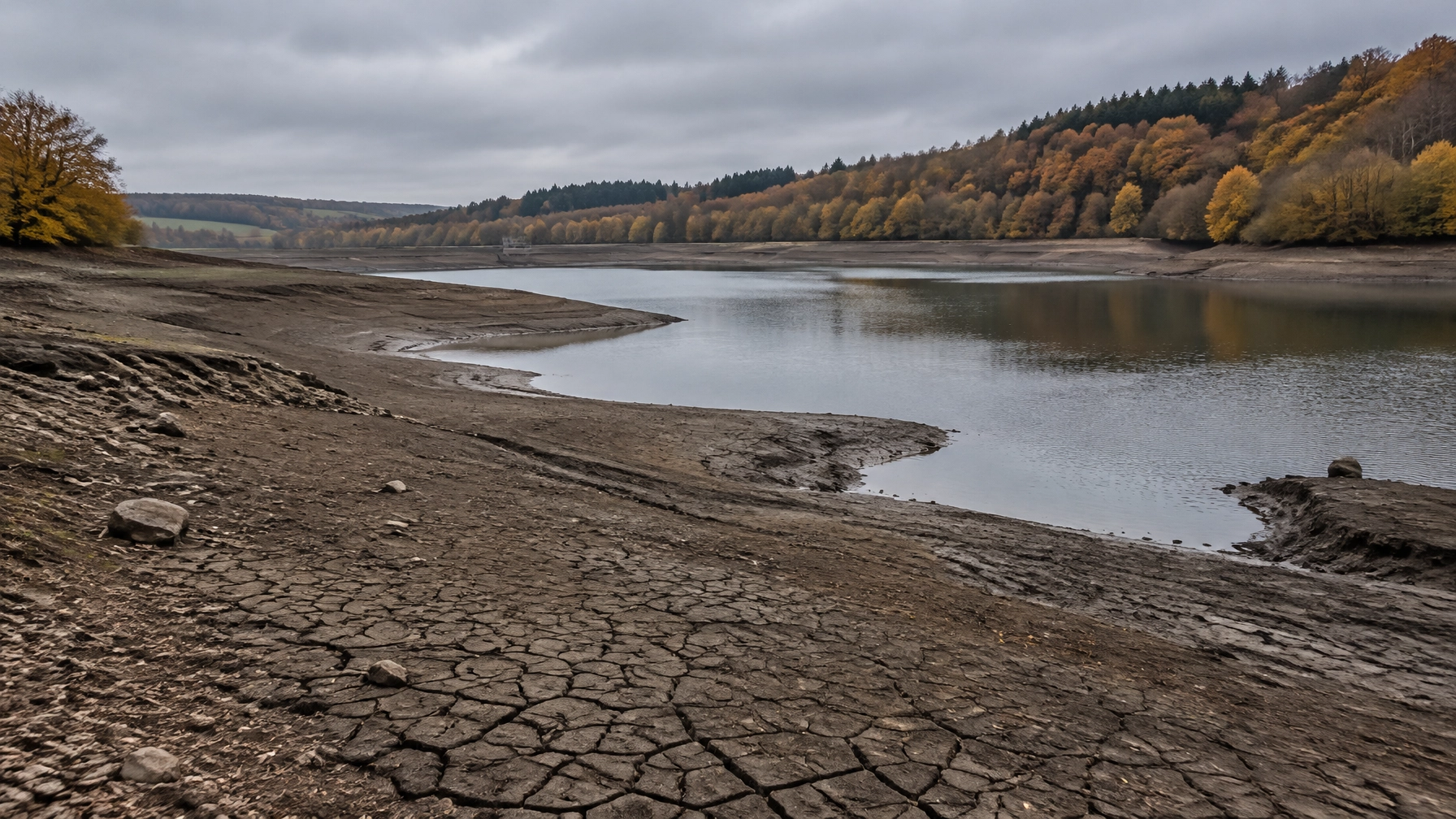
On 15 October, the government declared severe drought in parts of Cornwall, Devon, Dorset, Somerset, East Sussex and West Sussex. It followed an exceptionally dry April-to-September period and low reservoir levels, according to GOV.UK and the Environment Agency.
The declaration does not cover every household in those counties. It applies to areas served by vulnerable reservoirs, including Ardingly in West Sussex and Wimbleball in Somerset. The Environment Agency reported that Wimbleball was 18% full on 4 October. That is a dated snapshot, not a current reservoir reading. See the Environment Agency’s 8 October update. Check your water company’s postcode advice to see what applies to you.
The government said customer supplies would remain uninterrupted as it announced measures including closer monitoring of reservoirs and rivers. The Environment Agency said the declaration does not automatically bring new restrictions, though suppliers may take further steps under their drought plans. BBC News also reported that some areas already had water-use restrictions in place, so check your supplier rather than assuming the declaration creates the same rules everywhere.
Restrictions on non-essential business water use are separate from an interruption to household drinking-water supplies. The Environment Agency confirmed South West Water had applied for a non-essential-use ban. On 19 October, the government published a ministerial direction concerning severe-drought water-resource zones around Wimbleball, Ardingly, Roadford and Colliford. Check your supplier’s current notice for the activities, dates and exemptions that apply locally.
A new Flood and Drought Resilience Taskforce was due to meet for the first time on 14 October. The government’s 11 October announcement said it would bring together representatives from more than 50 organisations. It complements the National Drought Group’s operational drought response. (GOV.UK taskforce announcement.)
🧭 Drought stages, in plain English
The Environment Agency describes escalating dry-weather conditions using these statuses:
- Prolonged dry weather (yellow): Dry conditions are persisting and monitoring or conservation measures may increase.
- Drought (amber): More significant action may be needed to manage water resources.
- Severe drought (red): The highest drought status, signalling serious pressure and a need for exceptional action.
These labels describe the wider water-resource situation. They do not tell you, on their own, whether your tap will run or whether a restriction applies to your home. The Environment Agency says severe drought does not automatically trigger restrictions and is not a civil emergency.
Water-company plans use their own action levels alongside these stages. The Environment Agency’s 2025 guidance links severe drought to level 3b extreme actions; level 4 emergency actions are set out separately. These are planning categories, not a prediction that those actions will be needed now. (Environment Agency drought-plan guidance, 2025.)
🚿 Save water without making life difficult
A few everyday habits can reduce avoidable use. They do not mean neglecting hygiene or drinking less.
- Keep showers a little shorter. Prepare’s drought guidance suggests considering a shower instead of a bath. You do not need to compromise on washing your hands.
- Run full loads. Use the eco setting on your washing machine or dishwasher when suitable, and avoid pre-rinsing dishes if your dishwasher instructions do not require it.
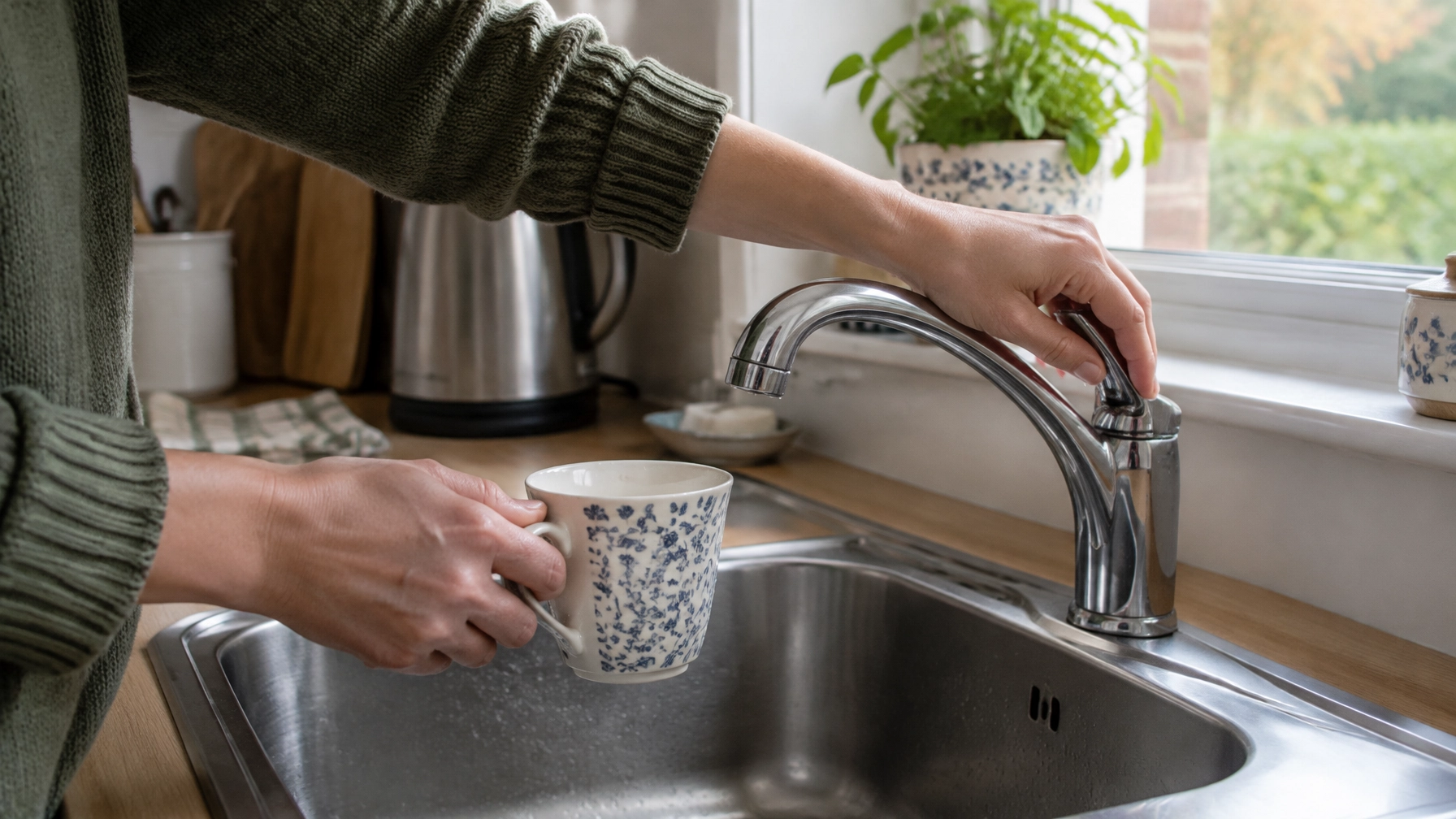
- Turn taps off when you do not need the water. For example, while brushing your teeth.
- Fix drips and leaks. If a leak is on your supplier’s side, report it; inside your home, arrange a repair.
- Use garden water carefully. Follow any local restrictions and avoid leaving a hose running.
These steps reflect Prepare’s drought advice and advice from the Environment Agency and UKHSA. Keep drinking enough, especially in warm weather. UKHSA says not to reduce your fluid intake to conserve water.
🧴 What sensible emergency water storage looks like
An emergency supply is useful for a burst main or another local interruption. It is not a reason to panic-buy or fill every container in the house.
The UK Prepare service, citing the World Health Organization, recommends 2.5–3 litres of drinking water per person per day. For a family of four, that means 30–36 litres for three days, for drinking alone. You may need more for cooking, basic hygiene, babies, pets or medical needs. (Prepare: water supply interruptions.)
For straightforward storage:
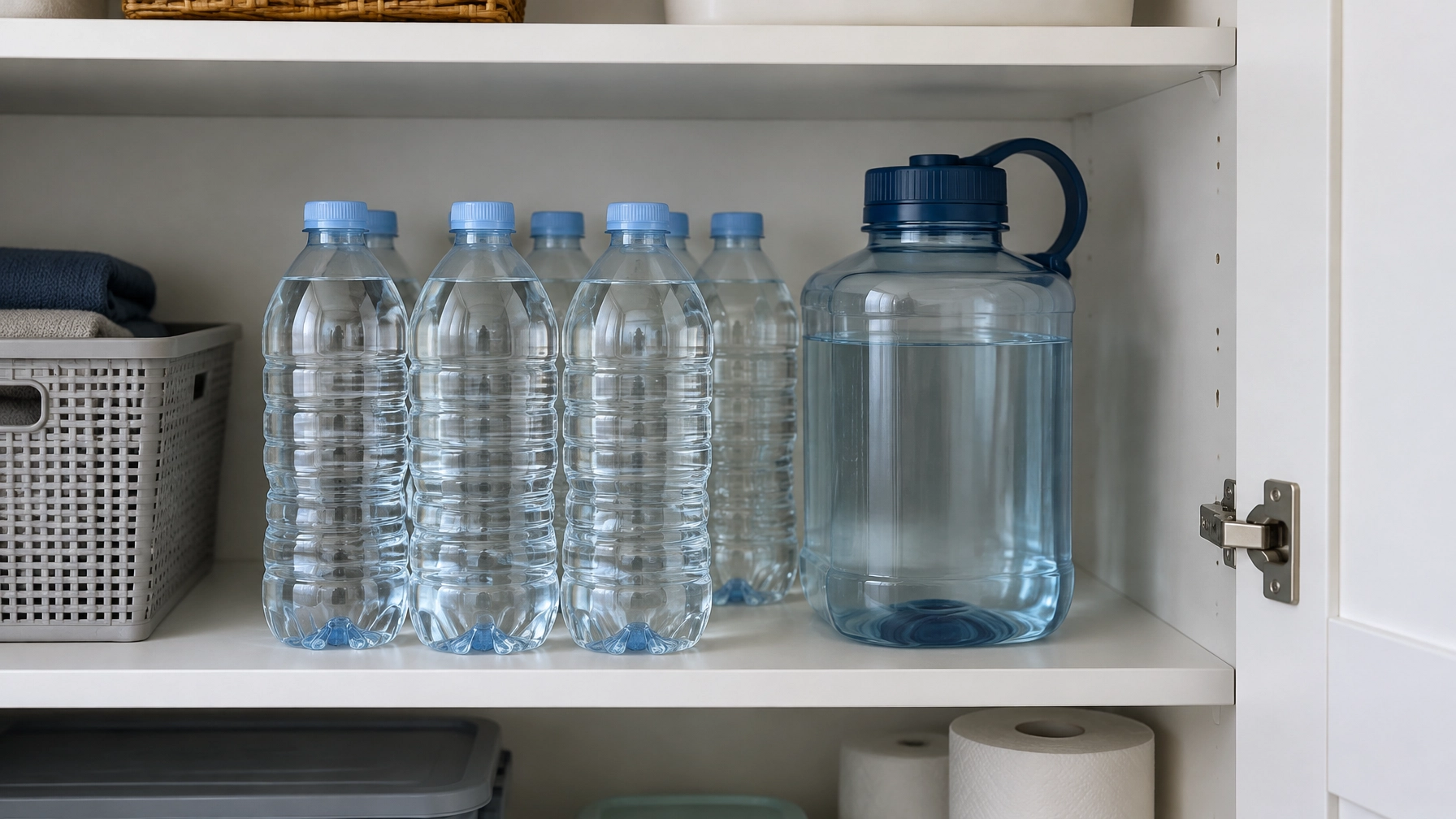
- Start with sealed bottled water. Prepare recommends buying and storing it rather than filling household containers.
- If you use a reusable container, choose one made for food and water, and follow its cleaning and storage instructions.
- Keep supplies cool and out of direct light. Check dates and rotate them as directed by the packaging.
- Do not refill old milk bottles. They are not designed for long-term drinking-water storage and can be difficult to clean thoroughly.
- Keep any water set aside for pets, formula or medical equipment in your calculations.
A water butt can be useful for plants or toilet flushing where suitable. Do not use untreated collected rainwater for drinking. Boiling kills many germs but does not remove chemical contamination; a camping filter is not a guarantee of safety either. Use your supplier’s recommended drinking-water source.
For more on safe water treatment, see our guides to boiling water without power and water filters.
📱 If you get a supply warning or pressure drops
Your water company is the best source for local information. Prepare recommends checking its website during an outage and following its advice.
- Check the exact message. A supply interruption, a boil-water notice and a “do not drink” warning call for different actions. Follow the wording from your supplier.
- Keep taps closed if the supply stops. Check for updates before turning them on again.
- Contact your supplier if pressure falls or the water changes colour, taste or smell. UKHSA advises reporting changes in water quality or pressure.
- Use your stored supply for essential needs while you wait for further instructions.
- Do not fill baths from hot taps in anticipation of an outage unless your water company advises it. Follow the supplier’s specific instructions on storing or using water.
If you or someone in your household depends on water for a medical device, or may need extra help during an interruption, contact your supplier about its Priority Services Register. Prepare also advises households to plan for babies, pets and medical needs.
✅ Quick-reference checklist
🧭 Prepared, not paranoid
The severe drought declaration is a signal that water resources need careful management. It is not a reason to panic or to assume your household is about to lose its supply. Stay informed, make sensible use of water and keep a modest emergency supply that suits your household. Preparedness is about confidence, not fear.
From the EODSurvival shop
Our 72-Hour Household Plan helps you work out what your household needs for a short disruption, including water, food and other essentials. This is a commercial EODSurvival product, based on GOV.UK and EU preparedness guidance. EODSurvival is an independent publication, not a government publication.
❓ FAQs
Sources
- Department for Environment, Food & Rural Affairs, “Government activates plan to protect consumers as severe drought declared in parts of England”, 15 October 2026.
- Environment Agency, “What is severe drought?”, 15 October 2026.
- BBC News, “Severe drought declared in parts of southern England”, 15 October 2026.
- The Guardian, “Severe drought declared in six areas of England as public water supplies under threat”, 15 October 2026.
- Department for Environment, Food & Rural Affairs, “New taskforce to boost Britain’s resilience to flooding and drought”, 11 October 2026.
- Prepare, “Water supply interruptions or outages”, accessed 16 October 2026.
- UK Health Security Agency, “Public health impact of drought: advice for the public”, published 28 July 2022; updated 13 November 2024.
- Environment Agency, “Water company drought plan guideline, 2025”, 2025.
Build your household water plan
Our free Food & Water guide helps you prepare for a short local disruption.