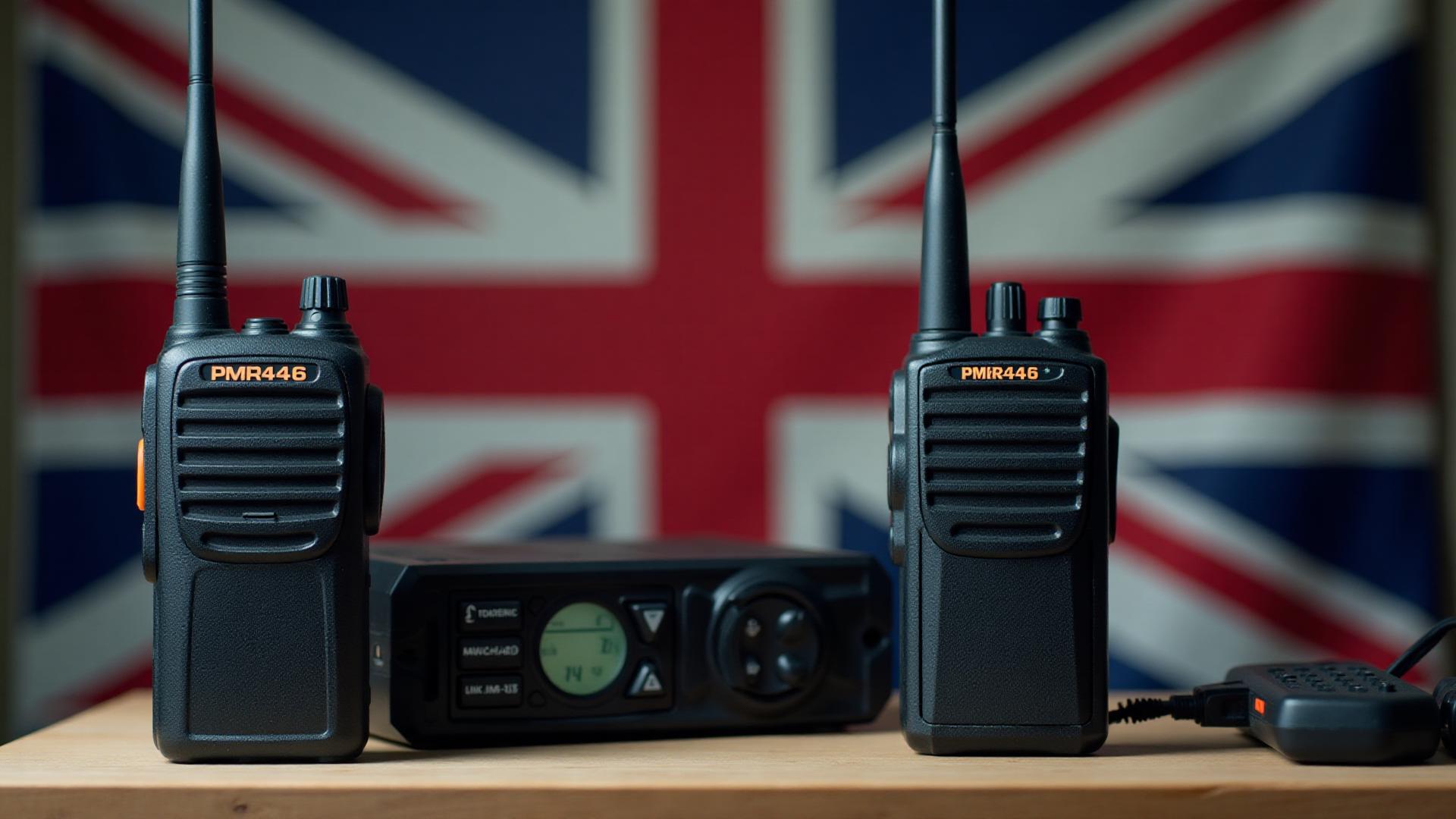
Why PMR446 matters in a UK blackout
Mobile networks can get congested or go down during storms and wide-area power cuts. PMR446 handhelds give you simple, legal, line-of-sight voice comms—perfect for family coordination, neighbour check-ins, and local volunteering. You don't need a licence, there's almost no setup, and the gear is affordable.
PMR446 in one minute (the rules that actually matter)
Band: 446.0–446.2 MHz (UHF) with channel plans for analogue and digital sets. The extension to the full 446.0–446.2 MHz increased capacity across the UK/EU.
Power limit: 0.5 W ERP maximum (built into compliant radios).
Form factor: Handheld only with integral (non-removable) antenna and integrated battery to meet the ETSI EN 303 405 standard used for UK compliance.
Licence status: Licence-exempt under Ofcom's Wireless Telegraphy Exemption regime (you still must use compliant equipment).
Infrastructure: No base stations or repeaters—PMR446 is simplex, peer-to-peer only.
Roaming to EU: Analogue PMR446 is harmonised EU-wide; digital PMR446 isn't fully harmonised in every country—check local rules before traveling.
If your radio has a removable antenna, can transmit above 0.5 W, or supports external antennas/repeaters, it's not PMR446-compliant (and not licence-free).
Frequencies & channel plans (practical overview)
Analogue FM (NFM): 16 channels at 12.5 kHz spacing across 446.0–446.2 MHz (e.g., 446.00625, 446.01875 … 446.19375 MHz).
Digital (dPMR/DMR "446"): up to 32 digital voice channels using 6.25 kHz spacing within the same 446.0–446.2 MHz band.
Both analogue and digital sets often include CTCSS/DCS (analogue) or Colour Codes/TalkGroups (digital). These don't create privacy—they just reduce unwanted chatter by ignoring other users. Expect overlap on busy days.
Legal checklist before you buy (UK & EU)
- Look for UKCA/CE conformity and a declaration to ETSI EN 303 405 (PMR446 handheld standard).
- Integral antenna only. No SMA/BNC connectors.
- Stated as "PMR446" in the listing/manual (not "programmable 5 W walkie-talkie" or "ham/GMRS"—those aren't licence-free in the UK).
- Digital sets abroad: If you plan to travel, confirm local acceptance (analogue is broadly fine EU-wide; digital varies by country).
Analogue vs Digital PMR446 (which is right for you?)
Analogue (FM)
Pros:
Cheapest, simplest, widest compatibility; works with kids' walkie-talkies and most community groups.
Cons:
More background noise; less efficient channel use; no text features.
Digital (dPMR/DMR "446")
Pros:
Cleaner audio, more channels, optional basic text/ID features, and group calling tools (Colour Codes/TalkGroups).
Cons:
Costlier; not all digital flavours talk to each other; EU roaming isn't universally harmonised.
Bottom line: If your plan is family + neighbours, analogue is perfect. If you want clearer audio and organised groups (e.g., volunteer marshals), a digital set is worth it—just buy all the same model family.
Real-world range (no marketing fluff)
At 0.5 W ERP with stubby handheld antennas, expect:
- Streets/estates: a few hundred metres to ~1 km depending on buildings.
- Parks/coast/hills: 1–3 km, occasionally more from high ground.
- Indoors across streets: often one or two houses away.
Height wins. Put one operator in an upstairs window or on a hill and range improves dramatically. Metal, dense brick, valleys, and heavy rain all reduce range.
Recommended radio features for blackouts
- AA/AAA compatibility or USB-C charging so you can recharge from power banks.
- Dedicated volume and channel knobs (easier in the dark).
- NOAA/Weather isn't a UK thing—but FM broadcast radio receive is handy for news if mobiles fail.
- Emergency alert button that sends a loud tone to your group.
- IP rating (splash resistance) and drop rating for reliability.
Programming & etiquette (how not to be "that person")
- Pick a quiet channel and agree it with your group in advance.
- Use short calls: "Unit 1 to Unit 2—status?" then release.
- Listen before talking. If busy, add a CTCSS tone to filter—but remember it's not private.
- No foul language or harassment. It's a public service.
- No data bursts, repeaters, or modified antennas—outside PMR446 rules.
Example family setup (cost-effective)
- 4× Analogue PMR446 handhelds with USB-C charging and headsets.
- 1× Wind-up/solar radio (news + phone charge).
- 2× Spare battery packs or a power bank per radio.
- Printed channel card: "Primary Ch 3 (CTCSS 1); Secondary Ch 7 (CTCSS 3)."
- Check-in schedule during blackouts (e.g., on the hour, every hour).
Digital group setup (volunteers, residents' groups)
- 6–10× dPMR/DMR446 handhelds from the same series.
- Pre-program Colour Code and TalkGroups (e.g., TG1 "Ops", TG2 "Welfare").
- Assign call-signs, keep a message log, and rehearse radio checks.
- Consider earpieces for windy or crowded conditions.
Buying tips (what to avoid)
- Avoid "programmable 5 W" imports marketed as "PMR/ham/FRS/GMRS." Those aren't licence-free in the UK and can cause harmful interference.
- Be wary of fake conformity marks—buy from reputable UK/EU retailers listing UKCA/CE and a Declaration of Conformity referencing EN 303 405.
- If you're tempted by vehicle or home "PMR446 base stations," note: if it's not a handheld with integral antenna, it's not legal licence-free.
Ofcom & legal references (plain-English wrap-up)
- Licence-exempt status: PMR446 is covered under UK Wireless Telegraphy (Exemption) Regulations (use compliant equipment only).
- Technical limits: 0.5 W ERP, handheld, integral antenna, integrated battery, and conformance to EN 303 405 for market placement.
- Frequencies: 446.0–446.2 MHz with analogue 12.5 kHz and digital 6.25 kHz channelisation as adopted across the UK, following the CEPT/ECC decisions that expanded capacity.
- EU travel: Analogue is harmonised; digital PMR446 rules vary—check before use.
- No repeaters/base stations: PMR446 is peer-to-peer only.
Quick FAQ (for searchers & skimmers)
Is PMR446 legal in the UK without a licence?
Yes—if you use a compliant handheld (integral antenna, 0.5 W ERP) sold for PMR446 and UKCA/CE marked.
What's the real range?
Typically hundreds of metres to a few kilometres, depending on buildings and terrain. Height helps more than power.
Can I connect an external antenna or a car aerial?
No. That breaks the integral antenna rule and voids licence-free status.
Do CTCSS/DCS give privacy?
No. They just reduce unwanted audio. Anyone on the same channel without your tone can still hear you.
Are digital PMR446 radios better?
They offer cleaner audio and more channels (dPMR/DMR), but cost more and may have country-specific limits abroad.
Final word: keep it simple, drill it once
For UK preppers, PMR446 is the sweet spot—legal, simple, and effective for street-level coordination during storms and blackouts. Buy compliant handhelds, agree a primary/secondary channel, practice short calls, and keep spare power in your blackout kit. You'll be far ahead of the curve when the phones get flaky.
Prepared, not paranoid. That's how you communicate when it counts.
Sources & references
- Ofcom – Wireless Telegraphy Exemption Regulations & guidance.
- Ofcom FOI (2023) – PMR446 equipment must be handheld with integral antenna & integrated battery; EN 303 405.
- Icom UK – CEPT/ECC changes expanding PMR446 to 446.0–446.2 MHz; channelisation.
- Radiotrader (UK) – practical summary of analogue/digital channels.
- Ofcom IR2009 Info Sheet – analogue harmonised EU-wide; digital not fully harmonised.
- dPMR Association – dPMR446 is licence-free, peer-to-peer (no repeaters).