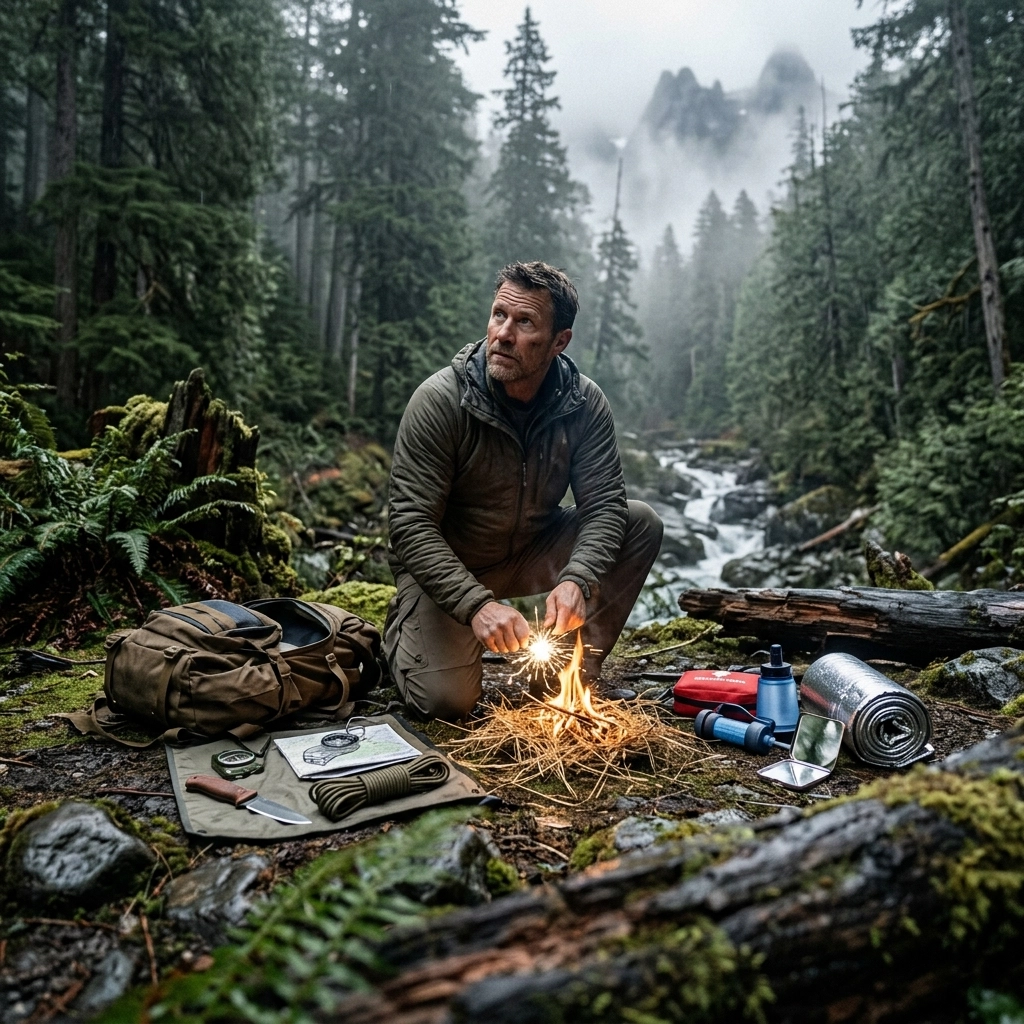
The Passive Penalty: Why Your Survival Gear List Won't Save You Alone
So, you've done it. You've spent three nights down a YouTube rabbit hole, your credit card is smoking, and there's a pile of cardboard boxes at your front door that would make a UPS driver weep. You've got the titanium spork, the 4k-lumen tactical flashlight, and a backpack so full of MOLLE webbing it looks like a nylon porcupine.
You feel ready. You feel safe. You feel like a "prepper."
But here's the cold, hard truth that most gear companies won't tell you: You've just paid the entry fee, but you haven't yet avoided the Passive Penalty.
In the world of emergency preparedness, there is a massive difference between owning a solution and being the solution. If your plan for a crisis relies entirely on the stuff in your bag rather than the skills in your head, you're operating under a dangerous deficit.
🛑 The "Amazon Prime" Delusion
When we talk about prepping for beginners, the first impulse is always to shop. Shopping feels like progress. Buying a high-end water filter feels like you've "solved" the water problem. Tossing a fancy emergency preparedness checklist into a drawer feels like you've "checked the box."
This is what we call the "Amazon Prime" delusion. It's the belief that survival is a product you can buy.
But gear is passive. It sits there. It doesn't know how to fix itself when it breaks, and it definitely doesn't know how to work itself when your hands are shaking, the lights are out, and you're under genuine stress. The Passive Penalty is the gap between what your gear can do and what you can do with it. If that gap is too wide, the gear becomes a liability. It gives you a false sense of security that prevents you from actually learning what you need to know.

🔧 What Exactly is "The Passive Penalty"?
Think of it like this: If you buy a Stradivarius violin but have never taken a music lesson, you don't have music — you just have an expensive piece of wood.
The Passive Penalty hits you in three specific ways during a crisis:
- The Stress Tax: Under high stress, your fine motor skills evaporate. If you've never practiced using your gear, you won't be able to figure it out when the stakes are high.
- The Maintenance Trap: Gear fails. O-rings dry out. Batteries leak. If you don't know how your gear works, you won't know how to maintain it or fix it when it inevitably goes sideways.
- The Doctrine Deficit: You might have the equipment, but if you don't have the "doctrine" (the plan for when and how to use it), you'll make poor decisions.
A classic example from our research is the IFAK (Individual First Aid Kit). Many people carry a top-tier medical safety kit but view it as a general toolbox for everyone. In a real tactical or survival scenario, your IFAK is for you. If you use your only tourniquet on a stranger because you didn't have a plan, you've just penalised your own survival chances.
🩹 Skills vs. Stuff: The Survival Ratio
If I had to choose between a guy with a $5,000 survival gear list and zero training, and a guy with a garbage bag and ten years of survival training, I'm betting on the garbage bag guy every single time.
Why? Because skills don't run out of batteries.
Let's look at the most common items on any emergency preparedness checklist and see how the Passive Penalty applies:
- The Water Filter: You have a Sawyers or a LifeStraw. Great. Do you know how to backflush it? Do you know what to do if it freezes and the internal membrane cracks (rendering it useless)? If not, you're paying the penalty.
- The Fire Starter: You have a ferrocerium rod. Can you start a fire with it in the rain? On a windy day? With nothing but damp wood? If you've only ever used it on a dry Saturday in your backyard, you're in for a shock.
- The Power Station: You bought a big battery for power blackouts. Do you know how many watts your fridge pulls? Do you know how long that battery will actually last, or are you just "hoping" it's enough?

🧠 Mindset: The Ultimate Tool
Our research into military survival doctrine is clear: The will to survive is more important than the kit in your bag.
Tools and training are useless without the psychological determination to use them. The "Passive Penalty" isn't just about technical skill; it's about mental readiness. When things go wrong, the person who relies on their gear panics when that gear fails. The person who relies on their mindset simply looks for the next solution.
This is why prepping for beginners should focus 20% on gear and 80% on knowledge. You want to reach a point where your gear is an extension of your capabilities, not a replacement for them.
🛠️ How to Overcome the Penalty
Ready to stop being a passive owner and start being an active survivor? Here is how you bridge the gap:
1. Stress-Test Everything
Don't wait for a disaster to find out your stove is finicky. Turn off the breakers in your house for a weekend. Live off your food and water prep. Try to set up your emergency comms in the dark. You'll quickly find the "bugs" in your system.
2. Learn the "Why," Not Just the "What"
Instead of just following a survival gear list, learn the principles behind the items. Don't just buy a bandage; learn how blood clotting works. Don't just buy a radio; learn the basics of signal propagation.
3. Practice "Adversarial" Prepping
Imagine your primary piece of gear just broke. Now what? If your water filter fails, do you know how to boil water or use chemical purification? Having a "Plan B" that relies on skill rather than a second piece of gear is the best way to beat the Passive Penalty.

📋 The "Active Survivor" Checklist
Before you buy another piece of tactical nylon, run through this list. If you can't check these off, you're still paying the penalty.
- Do I know how to maintain this? (Cleaning, sharpening, battery replacement, software updates).
- Have I used this under "sub-optimal" conditions? (Rain, dark, cold, or while tired).
- Do I have the physical fitness to carry/use this? (A 50lb bug-out bag is a paperweight if you can't walk a mile with it).
- Do I have a manual backup? (If the GPS fails, can I use a map and compass?).
- Is this gear for me, or am I hoping someone else will use it on me? (Especially relevant for medical gear).
🚀 Moving Forward at EoDSurvival
At EoDSurvival, we're big fans of gear — don't get us wrong. We love a well-engineered tool as much as the next person. But we're even bigger fans of capability.
We want to help you move from being a "collector" to being a "practitioner." Whether you're looking for survival gear reviews that actually tell you the truth or downloadable guides to help you build real-world skills, we've got your back.
Remember: The goal isn't to have the most stuff. The goal is to be the person who knows what to do when the stuff stops working.
Stop paying the Passive Penalty. Start training.
Quick Reference Summary
| Factor | The Passive Approach (The Penalty) | The Active Approach (The Solution) |
|---|---|---|
| Gear | Buy it and store it in the box. | Unbox it, test it, and break it in. |
| Knowledge | "I'll Google it when I need it." | "I've practiced this until I can't get it wrong." |
| Mindset | Reliance on external tools for safety. | Reliance on personal adaptability. |
| Planning | Follows a generic list found online. | Customizes a plan based on local threats. |
❓ Frequently Asked Questions
What is the Passive Penalty in survival prepping?
The Passive Penalty is the gap between what your gear can do and what you can do with it. It covers the Stress Tax (losing fine motor skills under pressure), the Maintenance Trap (gear failing because you don't know how to maintain it), and the Doctrine Deficit (lacking a plan for when and how to use your equipment).
Should I focus on buying gear or learning skills?
Focus 80% on knowledge and skills, 20% on gear. Skills don't run out of batteries. A person with minimal gear and solid training will outperform someone with expensive equipment and no practice every time.
How do I test my survival gear before an emergency?
Stress-test by simulating a power outage for a weekend, using your gear in rain or darkness, and practising adversarial prepping — imagining your primary gear has failed and finding a skill-based backup.
Want More Survival Training?
Explore our complete collection of survival guides and preparedness resources
View All Training Guides