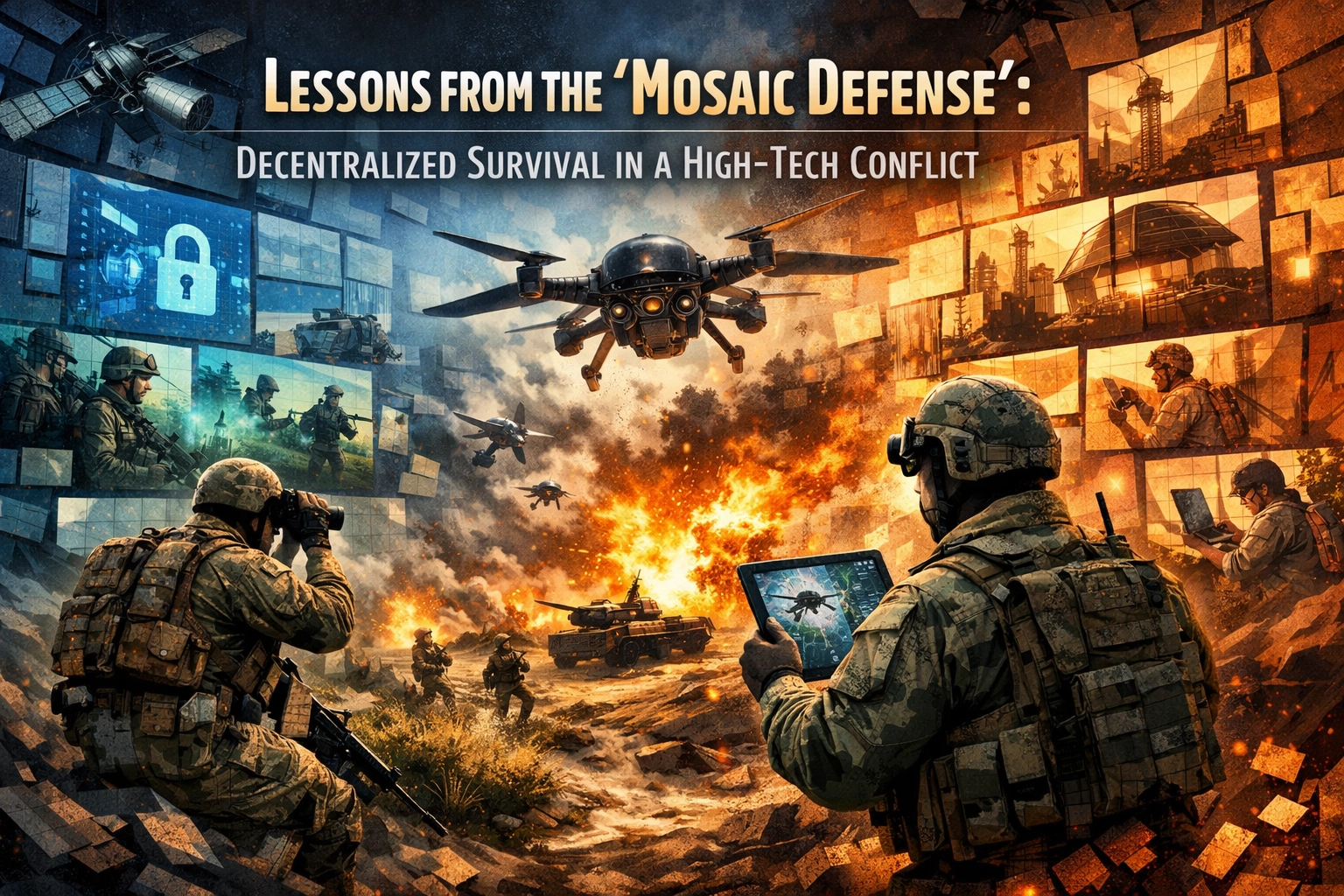
Lessons from the 'Mosaic Defense': Decentralized Survival in a High-Tech Conflict
As we discussed in Part 1 of this series, the 2026 Hormuz Crisis isn't just a "news event" happening thousands of miles away. It's a direct hit to the UK's energy supply, a 12-day countdown for our gas reserves, and a masterclass in modern, asymmetric warfare.
While the world watches the Strait of Hormuz, survivalists are watching the strategy. Iran isn't trying to fight a conventional ship-to-ship battle with the West. They know they'd lose. Instead, they're using something called the 'Mosaic Defense.'
It's a strategy of swarms, decentralized cells, and distributed power. And if you're still relying on a single "fortress" home or one massive bug-out bag, you're missing the biggest survival lesson of the decade.
In a high-tech conflict where supply chains are brittle and energy is a weapon, you need to stop thinking like a castle and start thinking like a mosaic.
🛡️ What is the 'Mosaic Defense'?
In 2005, the Iranian Revolutionary Guard Corps (IRGC) restructured their entire military into 31 separate commands, one for each province. The goal was simple: if the central government in Tehran is "decapitated" or the national communications grid goes dark, each province can keep fighting independently.
They don't rely on one big, expensive aircraft carrier. They use thousands of small, fast boats, cheap drones, and hidden missile batteries. It's the "death by a thousand cuts" approach.
For us, the lesson is clear. If your survival plan depends on one single point of failure — like your house, your local supermarket, or even a single specialized piece of tech — you aren't prepared. You're vulnerable.

🧩 Principle 1: The End of the 'Fortress' Mentality
Most people think of prepping as building a fortress. You stock the pantry, board the windows, and wait it out. But in 2026, we're seeing that "fixed targets" are the first to suffer. Whether it's a cyber-attack on the power grid or a physical disruption of local infrastructure, being tied to one spot can be a trap.
Distributed Survival means spreading your resources. Instead of one massive stockpile, you need multiple smaller caches.
The Strategy of Caching
If you have to leave your home quickly, you can't carry six months of food. You need to have "stepping stones" to your destination.
- The Home Base: Your primary resource.
- The Vehicle Cache: Part of your urban survival kit essentials.
- The External Cache: A buried or hidden spot within walking distance of your likely route out of the city.
By distributing your gear, you ensure that if one "cell" of your plan is compromised, the rest of the mosaic remains intact.
🎒 Principle 2: Urban vs. Wilderness — The Hybrid Kit
The Mosaic Defense uses whatever tools are available in the local environment. In the city, that means blending in. In the mountains, it means disappearing.
Your gear needs to be just as adaptable. We often see preppers split into two camps: the "Tactical Urbanites" and the "Bushcraft Purists." In 2026, you need to be both.
Urban Survival Kit Essentials
When the grid flickers, your urban kit isn't about fighting off zombies; it's about navigation and utility.
- Silcock Key: To access water from commercial buildings.
- Portable Power: Small solar panels and high-capacity banks to keep your comms alive.
- Grey Man Gear: Bags that don't look like "survival" bags. You want to look like a commuter, not a target.
The Bushcraft Gear List
If the crisis forces you out of the city and into the green belt, your needs change instantly. You aren't looking for a plug socket anymore; you're looking for fire and shelter. Your bushcraft gear list should be lightweight but indestructible:
- Full-tang Knife: For processing wood and making tools.
- Ferrocerium Rod: Because lighters fail and matches get wet.
- Tarp and Cordage: Rapid shelter that weighs almost nothing.

🧠 Principle 3: Skills as "Software" (That Can't Be Hacked)
The genius of a decentralized command is that every unit knows what to do without being told. They have the "software" — the training and the doctrine — embedded in their DNA.
In a crisis, your gear is only as good as your wilderness survival skills. If someone takes your bag, do they take your survival? If the answer is yes, you haven't prepped enough.
The Survival Skill Mosaic
- Water Procurement: Knowing how to filter urban runoff vs. finding groundwater in the woods. (Check our food and water guide for more).
- Navigation: Being able to read a paper map and use a compass when GPS is "spoofed" or down.
- Medical First Aid: Treating trauma or infection without a functioning A&E. Our medical safety section covers the basics of what you need to know.
📡 Principle 4: Decentralized Communications
When the Strait of Hormuz closed, one of the first things to get wonky was global shipping data and regional internet traffic. In a "Mosaic" setup, you don't rely on the "big net."
You need a way to talk to your family or group that doesn't involve a cell tower. We've talked about this a lot at EoDSurvival, but the current crisis makes it urgent.
- PMR446 Radios: For short-range, line-of-sight comms.
- SDR (Software Defined Radio): To listen to emergency broadcasts and news from across the globe when local channels are censored or down.
- Analog Backups: Physical meeting points and "dead drops" for messages.

🛠️ Action Plan: Build Your Own Mosaic
Don't wait for the 12-day gas reserve to hit zero. Start decentralizing your life this weekend.
1. Conduct a "Single Point of Failure" Audit
Look at your life. If the electricity goes off, can you cook? If the water stops, do you have three days' worth ready? If your front door is blocked, do you have another way out? Identify the "centres" in your life and create "peripheries."
2. Build a "Modular" Go-Bag
Instead of one giant rucksack, use smaller, modular pouches.
- One pouch for Urban Essentials (multi-tools, masks, power).
- One pouch for Bushcraft (fire starting, cordage, knife).
- One pouch for Medical. This allows you to ditch weight or grab only what you need based on the situation.
3. Map Your Local Area
Find three water sources within a 5-mile radius of your home. Identify two alternative routes to your place of work or your "safe zone" that don't use main motorways.
🏁 The Takeaway
The Mosaic Defense is about resilience through distribution. It teaches us that being big and centralized makes you a target, but being small, skilled, and scattered makes you impossible to defeat.
In 2026, the world is proving that the "old ways" of security — big governments, big grids, big stores — are fragile. Your survival depends on your ability to break your plan down into independent, functional pieces.
Stay tuned for Part 3, where we'll dive into the New Missile Reality and what it means for domestic safety in an age of long-range disruption.
Ready to start your decentralized journey?
- Download our Communications Guide to get off the grid.
- Check out our latest gear reviews for the best modular kit options.
Quick Checklist for the Mosaic Survivalist
- Split your food storage into at least two different locations.
- Add a Silcock key and a high-quality map to your urban kit.
- Practice one new wilderness survival skill this month (fire lighting is a great start).
- Set up a "Meeting Point Alpha" with your family that doesn't require a phone to coordinate.
Confidence comes from readiness. Let's get to work.
Frequently Asked Questions
What is the Mosaic Defense strategy?
The Mosaic Defense is a decentralized military strategy where forces are split into independent, self-sufficient cells. If one is destroyed, the rest continue operating. For preppers, it means distributing resources and skills so no single point of failure can compromise your survival plan.
What should be in a hybrid urban-bushcraft survival kit?
A hybrid kit includes urban essentials (silcock key, power bank, grey man bag, maps) and bushcraft gear (full-tang knife, ferrocerium rod, tarp and cordage) in modular pouches you can grab based on the situation.
How do you set up decentralized survival caches?
Split your supplies into at least three locations: your home base (primary stockpile), a vehicle cache (urban survival kit essentials), and an external cache buried or hidden along your likely evacuation route.
Want More Survival Training?
Explore our complete collection of survival guides and preparedness resources
View All Training Guides