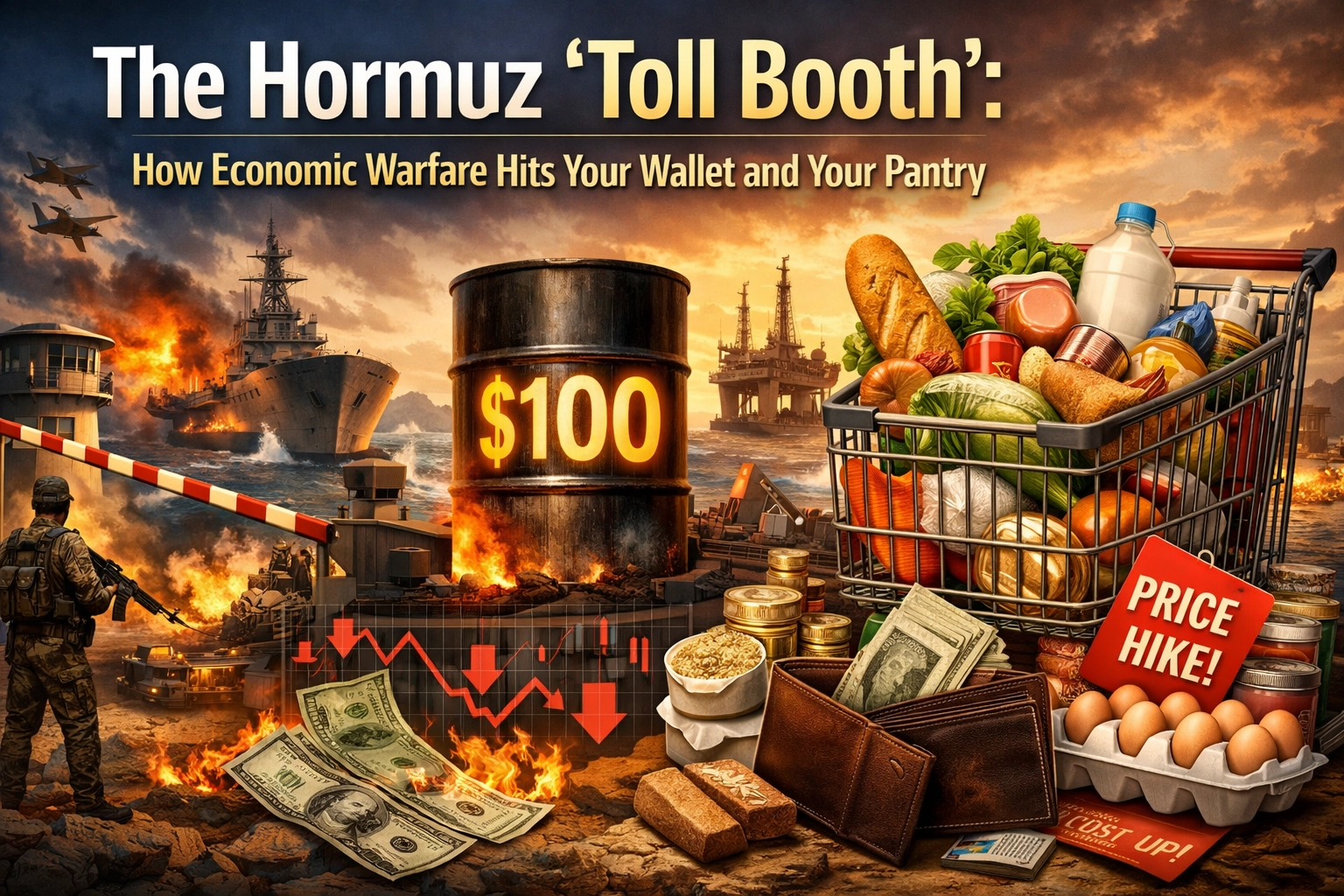
Imagine waking up, heading to your local petrol station, and seeing the price per litre has jumped by 30 pence overnight. You head into the supermarket for a loaf of bread and a pint of milk, only to find the shelves looking a bit thin and the prices looking a bit fat.
This isn't a hypothetical "prepper fantasy": it is the reality we are staring down right now due to events happening thousands of miles away in a narrow stretch of water called the Strait of Hormuz.
As of yesterday and today, March 26-27, 2026, the situation in the Middle East has shifted from military posturing to direct economic warfare. Iran's Islamic Revolutionary Guard Corps (IRGC) has effectively turned one of the world's most vital shipping lanes into a private "toll booth."
For those of us focused on preparedness, this isn't just a headline on the evening news. It is a direct hit to your wallet and, potentially, your pantry. Here is what you need to know and how you should be reacting.
⛽ The $200 Barrel Shadow: The Toll is Real
The Strait of Hormuz is the world's most important oil chokepoint. To put it simply, about 20% of the world's petroleum and liquefied natural gas (LNG) passes through this tiny gap. If you want to keep the lights on in London or the cars running in Manchester, that oil needs to flow.
But right now, it isn't flowing freely. The IRGC has begun demanding "safe passage" fees from commercial tankers. We aren't talking about a few pounds at a bridge crossing; we are talking about massive, multi-million-dollar fees just to move through international waters.
What does this mean for you?
- Skyrocketing Energy Costs: Global oil prices are already spiking. Analysts are modeling scenarios where oil hits $100 or even $200 per barrel if this continues.
- Insurance Nightmares: Maritime insurance companies have seen the risk and are jacking up premiums. When it costs more to insure a ship, the company doesn't just eat that cost: they pass it directly to the person buying the cargo. That's you.
- The "Toll" at the Pump: Expect to see these costs reflected at the fuel pump within days, not weeks.

🛒 Why the "Toll Booth" is Emptying Your Pantry
You might think, "I don't drive much, so I'm fine." Unfortunately, economic warfare doesn't work like that. Everything in your house: from the beans in your cupboard to the smartphone in your pocket: likely spent time on a ship.
When 20% of the world's energy is held hostage, the entire global supply chain begins to groan. Shipping companies are faced with a choice: pay the exorbitant IRGC "toll," or take the long way around the Cape of Good Hope. Taking the long way adds weeks to delivery times and burns massive amounts of extra fuel.
Either way, the result is the same: Hyper-inflation of everyday goods.
We've already seen supply chain delays of two to four weeks starting to propagate. If a supermarket can't guarantee when their next shipment of tinned goods or fresh produce is arriving, they raise prices to manage demand. This is the "toll" being taken on your pantry.
If you haven't checked your long-term food supplies lately, now is the time. You can check our food and water guides to see what you should be prioritising before the next price hike hits.
🗓️ The April 6th Deadline: A Window of Volatility
The geopolitical situation is moving fast. The US has recently extended a deadline for Iran to reopen the Strait and cease these "toll" tactics to April 6th.
This puts us in a very dangerous "grey zone" for the next ten days.
- If Iran blinks: Prices might stabilise, but they likely won't drop back to pre-crisis levels immediately.
- If the US and allies intervene: We could see a full-scale maritime conflict, which would shut the Strait entirely.
- If the status quo remains: The "toll" becomes the new normal, and we enter a period of sustained, grinding inflation.
This volatility is why we preach preparedness. You cannot control what happens in the Strait of Hormuz, but you can control how much fuel is in your tank and how much food is in your garage before April 6th arrives.

🛡️ Practical Steps for the Common-Sense Prepper
We don't do panic here at EoDSurvival. We do preparation. Here is how you should be handling the "Hormuz Toll" right now:
1. Top Off Your Tanks
If you have fuel storage at home, fill it. If you have a car, don't let it sit on empty. Fuel is likely the cheapest it will be for the next month today. If prices hit that $200 a barrel mark, you'll be glad you filled up when it was "only" expensive.
2. Audit Your Larder
Look at your "working pantry": the stuff you eat every day. If you see prices start to climb at the supermarket, resist the urge to buy just one. Buy two. If the supply chain takes a hit after the April 6th deadline, having an extra two weeks of food will keep you out of the "panic buying" crowds.
3. Review Your Power Options
With LNG shipments from Qatar also passing through the Strait, we could see a knock-on effect on domestic energy bills or even grid stability in extreme cases. If you've been thinking about a backup power solution, check out our resources on power blackouts.
4. Secure Your Communications
In times of economic and geopolitical tension, information is your best asset. Don't rely solely on mainstream social media, which can be prone to "rumour-mill" panic. Have a solid plan for staying informed. Our communications guide is a great place to start.

💰 The Bigger Picture: Economic Resilience
This situation is a perfect example of why survivalism isn't just about backpacks and tents. It's about economic resilience. When the world's "jugular vein" is squeezed, the people who suffer most are those who live "just in time."
The "just in time" lifestyle: relying on the shop being open every day, the petrol station having fuel every hour, and the grid being 100% stable: is a fragile one. By building a small buffer of supplies and knowledge, you move yourself out of that fragility.
The IRGC toll is a tax on the unprepared. Don't pay it if you don't have to.
📝 The "Hormuz Toll" Action Checklist
Use this list to ensure you're ready for whatever happens as we approach the April 6th deadline:
- Fuel: Fill all vehicles and secondary containers (safely and legally).
- Cash: Keep a small amount of physical cash on hand in case of digital payment glitches or bank "holidays" during high volatility.
- Pantry: Add 14 days of non-perishable "normal" food to your cupboards.
- Energy: Ensure any solar chargers or backup batteries are topped up and functional.
- Information: Bookmark our news section for updates as the deadline nears.
Stay calm, stay prepared, and keep a close eye on the calendar. We've handled supply chain hits before, and we'll handle this one too. It's all about staying one step ahead of the "toll."
If you found this helpful, consider downloading our full emergency checklist to make sure you haven't missed any other gaps in your setup.
Stay safe out there.