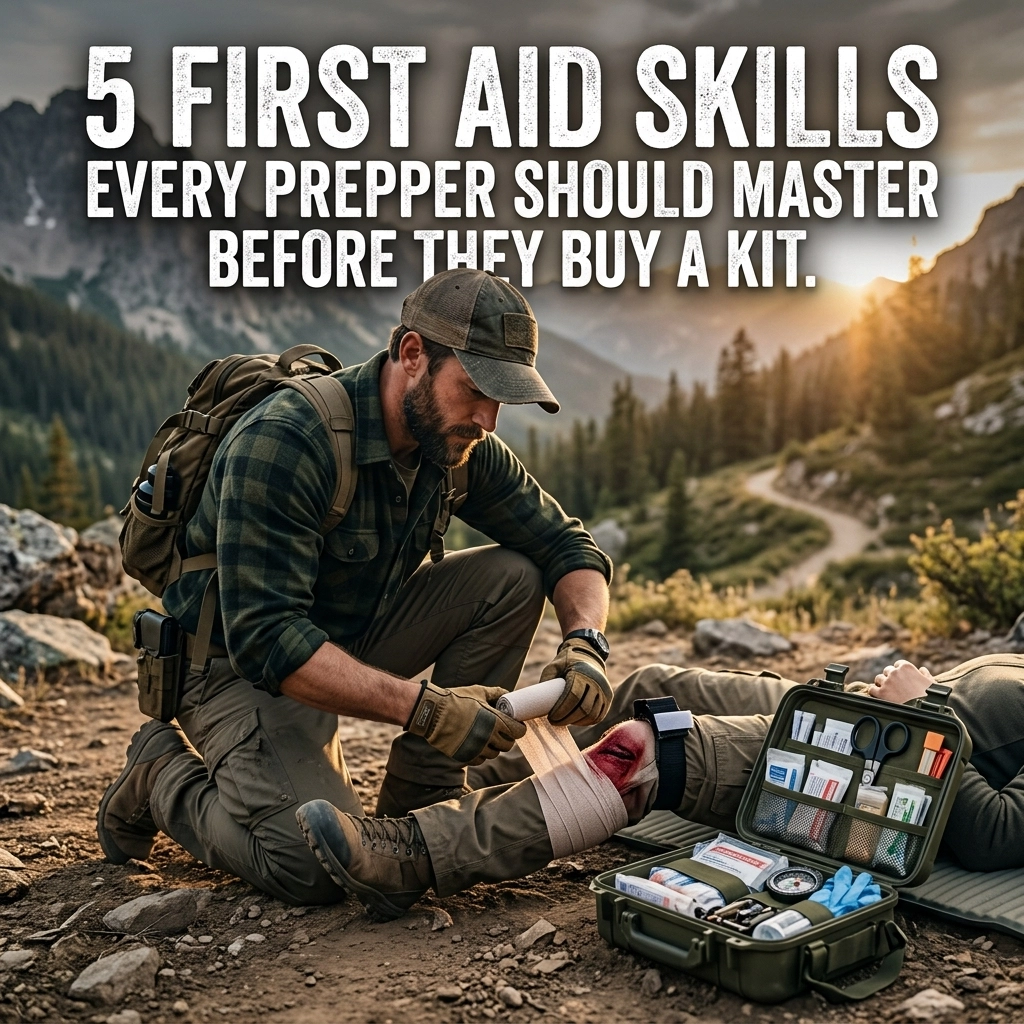
Imagine this: You've spent months researching the perfect Individual First Aid Kit (IFAK). You've dropped hundreds of pounds on military-grade tourniquets, chest seals, and Israeli bandages. You feel ready for anything.
Then, it happens. Your neighbour takes a nasty fall while clearing the gutters, or a kitchen accident leads to a deep, spurting cut. You grab your shiny new kit, rip open the Velcro, and... you freeze. You have the tools, but you don't have the "muscle memory." You're reading the instructions on the back of a packet while someone is losing blood.
At EoDSurvival, we see this all the time. People buy the gear because it's the easy part. It feels like "doing something." But in a real survival situation, gear is just a luxury. Your skills are the only thing you actually own.
Before you spend another penny on medical supplies, you need to master these five foundational skills.
🩸 1. Controlling Severe Bleeding (The "Life-Saver")
If someone has a major arterial bleed, they can bleed out in as little as three minutes. That is faster than an ambulance can get to most UK postcodes, even on a good day. If you don't know how to stop that leak, the rest of your medical training won't matter.
The Problem: Panic and Pressure
Most people's instinct is to dab at a wound with a tissue. That won't work for severe trauma. You need to be aggressive.
The Solution:
- Direct Pressure: This is your first line of defence. Lean into the wound with both hands. Use your body weight. Don't "check" to see if it's stopped every ten seconds — keep the pressure constant.
- Tourniquet Use: If the bleed is on a limb and direct pressure isn't working, you need a tourniquet. You need to know how to high-and-tight it, how to wind the windlass until the bleeding stops, and how to note the time.
- Packing the Wound: For "junctional" areas like the groin or armpit where a tourniquet won't work, you need to learn how to pack gauze deep into the wound and hold it.

You can find more on high-stress medical scenarios in our Medical & Safety section.
🩹 2. Wound Care and Infection Control
In a long-term survival or "grid-down" scenario, a simple scratch can kill you. Before the invention of antibiotics, sepsis and infection were leading causes of death. If the local GP is closed and A&E is overwhelmed, you are the doctor.
The Problem: The "Set and Forget" Mentality
Many preppers think putting a plaster on a cut is enough. It isn't. If dirt is trapped under that bandage, you're just culturing bacteria.
The Solution:
- Cleaning: Learn how to properly irrigate a wound with clean, running water or saline.
- Debridement: It sounds nasty, but you need to know how to remove debris from a wound without causing more trauma.
- Dressing: Understand the difference between a non-stick pad and gauze. Learn how to wrap a wound tight enough to stay on, but loose enough to maintain circulation.
- Observation: Learn the signs of infection: red streaks, warmth, swelling, and foul smells. Catching it early is the only way to survive without heavy-duty meds.
Check out our Survival Training guides for more on staying healthy when help isn't coming.
🫀 3. CPR and the Choking Response
Cardiac arrest and choking are "right now" emergencies. You don't have time to look at a manual or watch a YouTube video.
The Problem: Fear of Breaking Ribs
A lot of people hesitate to do CPR because they're afraid they'll hurt the person. Here's the truth: if their heart has stopped, they are already legally dead. You can't make them "deader." You might break a rib, but a broken rib heals. Death is permanent.
The Solution:
- Chest Compressions: Forget the "mouth-to-mouth" if you aren't comfortable. High-quality, fast, and deep chest compressions (to the beat of "Stayin' Alive") are what keep blood moving to the brain.
- The Heimlich Maneuver (Abdominal Thrusts): Learn the correct hand placement. For yourself, learn how to use the back of a chair to perform the maneuver if you're alone.
- AED Use: If there's an Automated External Defibrillator nearby (they are in most UK train stations and supermarkets now), know how to turn it on. The machine literally talks you through the process.

🥶 4. Recognizing and Treating Shock
Shock is a silent killer. It's what happens when the body's circulatory system fails, often after a trauma or a massive fright. You can "fix" a broken leg perfectly, but if the patient dies of shock an hour later, you've failed.
The Problem: Missing the Subtle Signs
Shock isn't always someone screaming. Often, it's someone becoming quiet, pale, and clammy.
The Solution:
- The W.A.R.M. Protocol:
- Warmth: Keep them warm. Use a space blanket or your own coat.
- Airway: Ensure they are breathing clearly.
- Rest/Reassurance: Keep them still and calm. Stress worsens shock.
- Manage Pain: Treat the underlying injury.
- Positioning: Generally, laying the person flat on their back and slightly elevating the legs can help blood flow to the vital organs — provided there isn't a head or spinal injury.
Understanding shock is a vital part of our Survival Training curriculum.

🪵 5. Splinting and Immobilization
In a survival situation, mobility is life. If you can't walk, you can't scavenge, you can't evacuate, and you can't defend yourself. However, moving a broken limb incorrectly can turn a simple fracture into a life-threatening internal bleed.
The Problem: Over-complicating the Fix
You don't need a fancy inflatable splint. You need to understand the physics of keeping a bone still.
The Solution:
- The Joint Above and Below: The golden rule of splinting is to immobilise the joint above and the joint below the break. If the forearm is broken, you need to secure the wrist and the elbow.
- Improvisation: Learn how to use a rolled-up newspaper, a sturdy branch, or even the person's own body (buddy-taping fingers or legs together) to create stability.
- Checking Circulation: Always check that your splint isn't too tight. Check for a pulse or "capillary refill" (press a fingernail and see if the colour returns quickly) below the injury site.
🎒 Gear vs. Skills: The Final Verdict
Don't get us wrong: having a high-quality medical kit is important. We have plenty of Survival Gear Reviews that will help you pick the best equipment. But gear is a force multiplier. If your skill level is zero, zero multiplied by a £500 kit is still zero.
Your Homework:
- Book a Course: Find a local St John Ambulance or British Red Cross course. There is no substitute for hands-on practice with a mannequin.
- Practice in the Dark: Once you know how to use a tourniquet, try doing it in the dark or with cold hands. That's what a real emergency feels like.
- Audit Your Kit: Go through your current medical supplies. Do you know how to use every single item? If not, either learn it or remove it.

Quick-Reference Summary Checklist
- Bleeding: Can I apply a tourniquet in under 30 seconds?
- Infection: Do I have a way to clean wounds if the water tap stops running? (See Food & Water for filtration tips).
- CPR: Do I know the current UK guidelines for chest compressions?
- Shock: Do I have a foil blanket in my "Go Bag" to prevent heat loss?
- Splinting: Can I identify the materials in my immediate environment to stabilise a limb?
Preparedness isn't about being scared of the world; it's about having the confidence to handle it. Start with your brain, then move to your bag.
Stay safe, stay prepared.
EoDSurvival Team
Want to dive deeper into emergency preparedness? Download our to see how your medical skills fit into your overall plan.